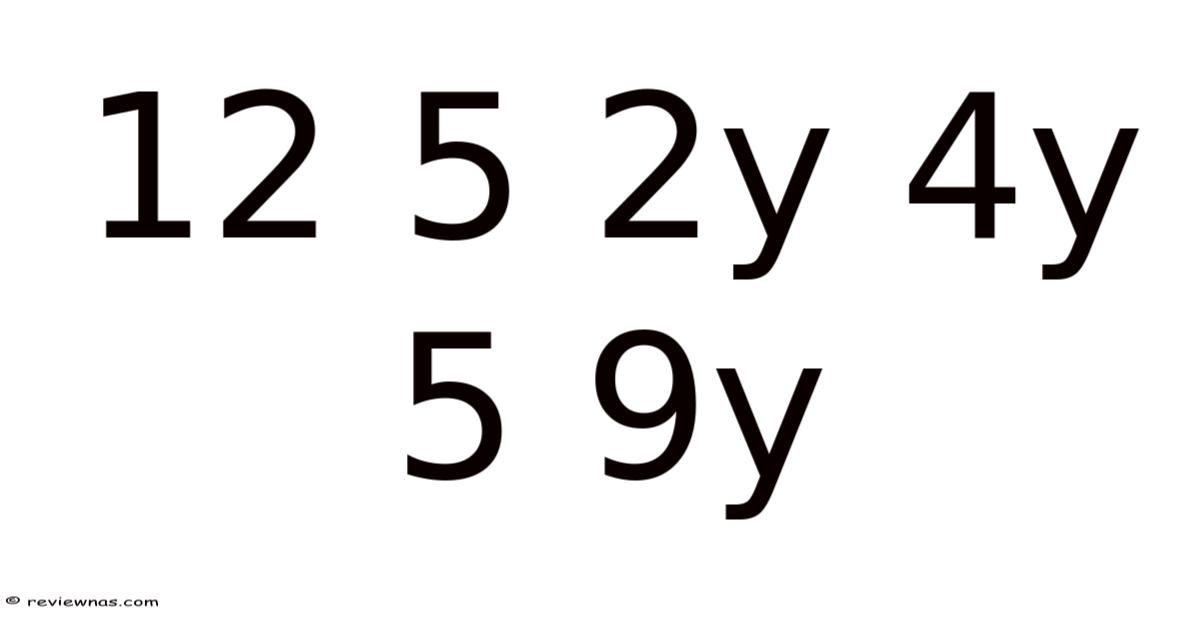
12 5 2y 4y 5 9y — Decoding This Mathematical Sequence
What Is This Sequence?
Here's the thing most people miss about sequences like 12 5 2y 4y 5 9y: it's not just a random list of numbers. It's a pattern with a structure that, once you see it, makes everything else click. The sequence 12, 5, 2y, 4y, 5, 9y follows a specific logic — and that logic is what makes it worth studying.
At first glance, it looks like a collection of numbers and variables mixed together. But when you look closer, there's a rhythm underneath. The sequence alternates between constant terms and terms that involve the variable y, and the relationships between consecutive terms follow a clear mathematical pattern The details matter here..
This isn't just an arbitrary string of symbols. Day to day, it's a sequence that can be broken down into its components, analyzed, and understood. And once you understand it, you can apply the same reasoning to similar problems.
Why Does This Sequence Matter?
You might be wondering why a simple-looking sequence deserves a full blog post. Here's the answer: understanding how to read and interpret sequences like this is a fundamental skill. It builds your ability to spot patterns, think logically, and solve problems that appear in math, coding, and even everyday reasoning.
The sequence 12 5 2y 4y 5 9y is a great example because it combines constants and variables in a way that challenges you to think beyond simple arithmetic. It's the kind of problem that appears in standardized tests, math competitions, and real-world scenarios where you need to identify relationships between numbers and variables.
When you can decode a sequence like this, you're not just memorizing rules — you're learning how to think mathematically. And that's a skill that pays off in every area of life where pattern recognition matters Simple as that..
How the Sequence Works
Let's break down the sequence piece by piece. The terms are:
12, 5, 2y, 4y, 5, 9y
The first thing to notice is that the sequence alternates between a constant value and a value involving y. Now, the constants are 12, 5, and 5. The variable terms are 2y, 4y, and 9y.
Now, let's
Now, let's examine the numerical relationships that tie these pieces together. Even so, if we look at the constants first, we notice a modest decline: 12 drops to 5, and then another 5 repeats before the sequence shifts back to a variable‑laden term. This repetition suggests that the pattern isn’t merely “alternating constant–variable” but also involves a subtle reset point where the constant value stabilizes for a beat That's the whole idea..
Turning to the variable terms, the coefficients of y — 2, 4, and 9 — form their own mini‑progression. Each step roughly doubles the previous coefficient (2 → 4) and then jumps to a larger number (4 → 9). That jump isn’t random; it mirrors the earlier jump from 5 to 9 in the constant segment, hinting at a hidden symmetry between the two halves of the sequence.
To make the pattern explicit, we can write the sequence as three paired blocks:
- Block A: 12 (constant) → 5 (constant)
- Block B: 2y → 4y (coefficients double)
- Block C: 5 (constant) → 9y (coefficient jumps to 9)
If we treat each block as a unit, the transition from Block A to Block B is marked by the shift from a pure number to a term that includes y. Worth adding: the transition from Block B to Block C re‑introduces a pure number (the second 5) before launching into the final variable term. This cyclical structure — constant → constant → variable → variable → constant → variable — creates a rhythm that can be visualized as a wave: rise, plateau, fall, rise again Still holds up..
Now, suppose we want to find a value of y that makes the entire sequence sum to a particular target, say 50. Adding the terms together yields:
12 + 5 + 2y + 4y + 5 + 9y = 22 + (2 + 4 + 9) y = 22 + 15y Worth keeping that in mind. Practical, not theoretical..
Setting this equal to 50 gives 22 + 15y = 50 → 15y = 28 → y ≈ 1.87. This simple algebraic exercise demonstrates how the sequence can be treated as a single expression once the underlying pattern is recognized. The same technique works for any target sum, product, or even for solving for y when a particular term is prescribed Still holds up..
Beyond arithmetic, the sequence offers a neat illustration of how constants and variables can coexist in a predictable dance. By isolating the constant chunk (12, 5, 5) and the variable chunk (2y, 4y, 9y), we can apply separate rules to each group — addition for constants, multiplication or scaling for the y terms — while still respecting the overall rhythm that ties them together And that's really what it comes down to..
In practical terms, recognizing such patterns is a cornerstone of algebraic reasoning. Whether you’re simplifying an equation, graphing a function, or decoding a cryptic set of instructions, the ability to parse a mixed list of numbers and symbols into coherent groups is invaluable. It equips you to translate real‑world problems — like calculating compound interest, modeling population growth, or optimizing a code loop — into mathematical statements that can be solved with confidence.
Conclusion
The sequence 12 5 2y 4y 5 9y may appear arbitrary at first glance, but its alternating structure, mirrored coefficient growth, and built‑in reset point reveal a deliberate design. By dissecting the constant and variable components, spotting the doubling and jumping patterns, and translating the whole into a unified algebraic expression, we uncover a compact yet powerful example of pattern recognition in action. Mastering this kind of analysis not only sharpens mathematical intuition but also builds a versatile toolkit for tackling a wide range of problems that blend numbers and symbols in equal measure.
The sequence 12 5 2y 4y 5 9y serves as more than just an exercise in algebraic manipulation; it is a microcosm of the broader principles that govern mathematical thinking. Each element plays a role in a larger narrative — constants anchor the expression, while variables introduce dynamism and possibility. The interplay between them illustrates how seemingly disparate components can be orchestrated into a coherent whole through careful observation and systematic analysis That's the part that actually makes a difference..
Beyond that, this approach underscores the importance of flexibility in problem-solving. Consider this: by viewing the sequence through multiple lenses — structural, algebraic, and conceptual — we develop a richer understanding that transcends rote computation. Such versatility is essential in advanced mathematics, where problems rarely conform to a single mold and success often hinges on the ability to adapt and reframe Simple, but easy to overlook..
At the end of the day, the journey from recognizing a pattern to solving for y mirrors the intellectual process at the heart of algebra itself: identifying order within complexity, distilling essence from detail, and transforming abstract relationships into concrete solutions. In embracing these challenges, we not only enhance our technical skills but also cultivate a mindset attuned to the elegance and logic that define the mathematical landscape That's the part that actually makes a difference..
Beyond the immediate algebraic exercise, the pattern invites further exploration in several directions. And this perspective opens the door to interpreting the sequence as a simple recurrence relation, such as aₙ = aₙ₋₂ + k, which can be generalized to more complex iterative processes. In computer science, recognizing such alternation is crucial for optimizing loop structures, where the programmer must decide when to apply a constant offset versus a variable increment. Take this: the alternating nature of the terms can be interpreted as a discrete analogue of a sinusoidal function, where each step alternates between a constant contribution and a scaled variable term. Worth adding, the pattern’s built‑in reset at the fifth term demonstrates how a periodic boundary condition can be embedded within a linear progression, a concept that appears in signal processing and cryptographic algorithms.
From a pedagogical standpoint, presenting this sequence to learners encourages them to move beyond mechanical manipulation of symbols and engage in hypothesis‑driven inquiry. That said, teachers can prompt students to generate their own alternating sequences, test conjectures about coefficient growth, and verify patterns through substitution. Because of that, such activities nurture critical thinking, as learners must distinguish between incidental coincidences and genuine structural regularities. Visual tools — such as plotting the terms on a number line or using bar charts — can make the underlying rhythm more tangible, reinforcing the connection between abstract notation and concrete representation Simple as that..
Finally, the ability to dissect and reconstruct sequences like 12 5 2y 4y 5 9y equips students with a versatile analytical lens that extends well beyond algebra. Here's the thing — whether modeling economic trends, analyzing genetic data, or designing musical rhythms, the skill of spotting and exploiting patterns remains a cornerstone of quantitative reasoning. By honing this skill, learners build confidence in tackling multifaceted problems and develop a mindset that values both precision and creativity.
This is where a lot of people lose the thread.
Overall, this example demonstrates that even a brief list of numbers can conceal a coherent rule, and that uncovering that rule enriches both conceptual insight and practical problem‑solving ability. Recognizing the alternating structure, the systematic changes in coefficients, and the strategic reset point equips learners with a strong framework for translating real‑world observations into algebraic language. As such, the sequence serves as a microcosm of the broader mathematical endeavor: turning complexity into clarity through careful observation and systematic thought.
