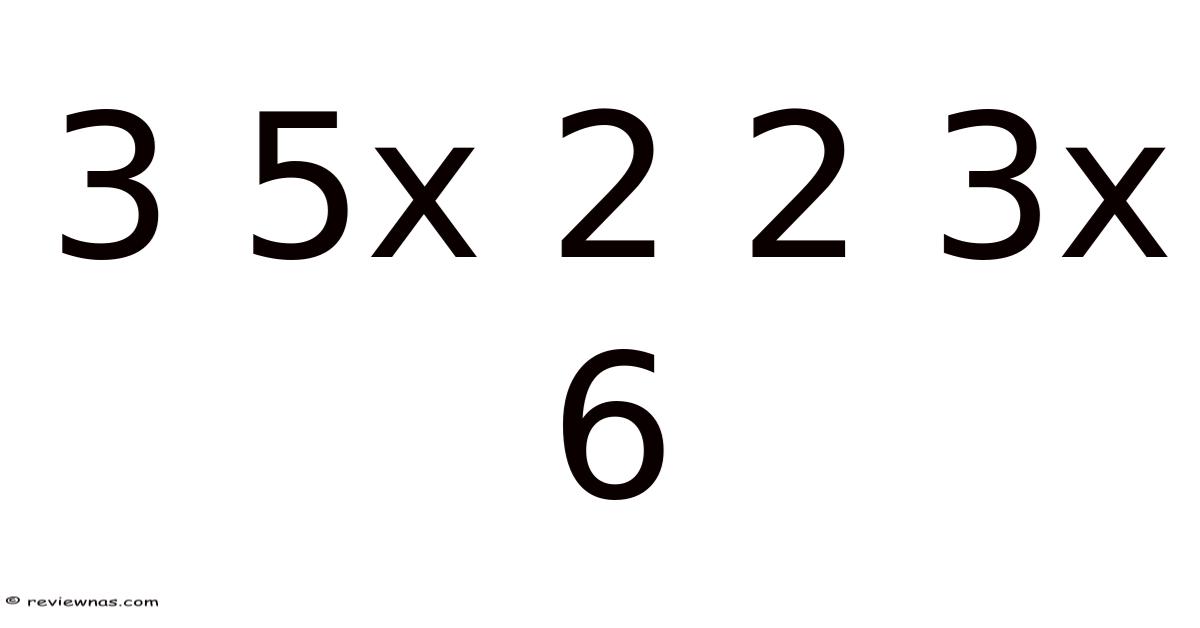
Have you ever sat there, staring at a page of numbers, and felt your brain just... stall?
It happens to the best of us. Worth adding: you’re looking at a math problem—maybe it’s for a kid’s homework, maybe it’s a quick mental calculation for a budget, or maybe it’s just a weird brain teaser—and suddenly, the symbols start swimming. You see something like 3 5x 2 2 3x 6 and your first instinct is to close the laptop and grab a coffee.
Here’s the thing: math isn't hard because the concepts are impossible. Worth adding: it’s hard because the way it’s presented is often messy, cluttered, and stripped of any actual context. We treat numbers like cold, hard facts, but when they are strung together without clear operators or structure, they become a puzzle And it works..
And honestly? Solving that puzzle is actually a great way to sharpen your mental agility.
What Is 3 5x 2 2 3x 6
If you look at that string of characters—3 5x 2 2 3x 6—you aren't looking at a single number. In real terms, you're looking at a sequence of mathematical operations that have been compressed into a single line. It looks like a typo, but in the world of algebra and arithmetic, it’s a specific type of expression That alone is useful..
Breaking Down the Symbols
To understand what this actually means, we have to strip away the clutter. When we see "x" in a string of numbers like this, we have to determine if it's a variable (like $x$ in algebra) or a multiplication sign ($\times$). In most casual or digital contexts, especially when written without spaces, that "x" is acting as the multiplier.
So, let's look at the components:
- We have the number 3. Which means - We have 5 times 2. - We have another 2.
- We have 3 times 6.
The Problem of Order
The real reason this looks confusing is the lack of clear grouping. In math, we usually rely on the Order of Operations—you might know it as PEMDAS or BODMAS. This is the set of rules that tells us whether to add, subtract, multiply, or divide first. Without these rules, a string of numbers is just a chaotic pile of digits But it adds up..
When you see something like 3 5x 2 2 3x 6, you are essentially looking at a multiplication chain. You aren't just looking at numbers; you're looking at a series of instructions telling you how to scale one value by another.
Why It Matters
You might be thinking, "Why am I spending time deconstructing this specific string of numbers? It’s just math."
But it's not. It's about computational thinking.
Whether you are a programmer writing a line of code, an accountant balancing a ledger, or a parent helping a child through a fifth-grade worksheet, the ability to parse a sequence of operations is vital. If you misinterpret a single symbol or skip a step in the sequence, the entire result collapses Which is the point..
In the real world, these errors aren't just "wrong answers" on a test. They are the reason a bridge is built with the wrong weight tolerance. They are the reason a bank account doesn't balance at the end of the month. They are the reason a software update crashes a system. Understanding how to take a complex, messy string of operations and break it down into manageable parts is a fundamental skill for navigating a world built on logic.
How It Works
Let's get into the meat of it. To solve an expression like 3 5x 2 2 3x 6, we have to assume the "x" represents multiplication and that the numbers are being multiplied sequentially.
Step 1: Identify the Operators
The first step is to stop seeing a "string" and start seeing "steps." We need to isolate each multiplication event.
Looking at the sequence:
-
- The first part is $3 \times 5$.
-
- The second part is that result $\times 2$.
- The third part is that result $\times 2$. The final part is that result $\times 3$. The last part is that result $\times 6$.
Wait, let's look closer at the original string: 3 5x 2 2 3x 6.
If we interpret the "x" as the multiplier, the expression is actually: $3 \times 5 \times 2 \times 2 \times 3 \times 6$
Step 2: The Sequential Approach
Every time you have a long string of multiplication, the order doesn't actually change the final result (this is the Commutative Property of multiplication), but it definitely changes how easy it is to do in your head No workaround needed..
Let's do it the long way first:
- $3 \times 5 = 15$
- $15 \times 2 = 30$
- $30 \times 2 = 60$
- $60 \times 3 = 180$
- $180 \times 6 = 1,080$
Step 3: The "Chunking" Method
Here's a tip that most people miss: you don't have to go one by one. You can group numbers together to make them easier to handle. This is how mathematicians keep their sanity.
Let's group them:
- Group A: $(3 \times 5) = 15$
- Group B: $(2 \times 2) = 4$
- Group C: $(3 \times 6) = 18$
Now we have: $15 \times 4 \times 18$.
This is much easier. Also, $15 \times 4 = 60$. $60 \times 18 =?
To do $60 \times 18$ in your head, just do $6 \times 18$ and add a zero. $60 + 48 = 108$. Consider this: $6 \times 8 = 48$. $6 \times 10 = 60$. Add the zero back: 1,080 Small thing, real impact..
Same answer. Much less headache.
Common Mistakes / What Most People Get Wrong
I've seen people trip up on this in dozens of different ways. Most of them aren't because they "can't do math," but because they are rushing or misreading the symbols And it works..
Confusing the Variable with the Operator
This is the big one. In algebra, $x$ is a placeholder for an unknown value. In arithmetic, $x$ is often used as a shorthand for multiplication. If you treat the $x$ in "3 5x 2" as a variable, the problem becomes unsolvable because you don't know what $x$ is. You have to look at the context. If there are no other equations provided, that $x$ is almost certainly a multiplication sign Small thing, real impact..
Ignoring the Sequence
Some people try to jump straight to the end. They see the 3 and the 6 at the ends and try to "guess" the middle. Math doesn't work on vibes. You have to account for every single digit in the string. If you miss one of those 2s in the middle, your entire calculation is off by a factor of two That's the part that actually makes a difference..
The "Mental Math" Trap
We often try to do these things in our heads to save time. But when a string gets long, our working memory reaches its limit. Most people can hold about 5 to 7 pieces of information in their head at once. A string like 3 5x 2 2 3x 6 has six different components. By the time you get to the last number, you've likely forgotten the first one Most people skip this — try not to. That's the whole idea..
Practical Tips / What Actually Works
If you want to get fast at solving these kinds of strings—whether for a test or just to feel sharper—here is what actually works.
- **Write it down, even if you think you don't need
Write it down, even if you think you don’t need to. Practically speaking, putting the whole expression on paper forces you to separate each number and each operator, which instantly reduces the chance of skipping a digit or mis‑reading a symbol. A quick scribble also creates a visual anchor you can glance back to while you’re working through the intermediate products, giving you a safety net for error‑checking.
Next, use parentheses deliberately. Even though multiplication is associative—meaning you can group factors in any way you like—introducing brackets can turn a tangled string into a series of bite‑size operations. Here's one way to look at it: rewriting (3 5× 2 2 3× 6) as ((3 5) × (2 2) × (3 6)) instantly reveals three simple products (15, 4, 18) that are far easier to combine The details matter here..
apply the distributive property whenever a number looks unwieldy. Plus, , treating 18 as 10 + 8) lets you multiply each part separately and then add the results. Here's the thing — splitting a factor into a sum of round numbers (e. Worth adding: g. In practice, (60 × 18) becomes (60 × 10) plus (60 × 8); the two products (600 and 480) sum cleanly to 1,080 without any mental juggling Most people skip this — try not to..
Another handy trick is to convert the whole string into a single addition problem. But since repeated multiplication by the same factor is just repeated addition, you can think of (3 5× 2 2 3× 6) as adding 15 four times (because of the two 2s) and then adding 18 three times (because of the 3 × 6). This “count‑by‑jumps” approach often surfaces patterns that aren’t obvious when you’re staring at the symbols alone.
Finally, develop a habit of quick sanity checks. If the two calculations converge on the same number, you’ve likely avoided the most common slip‑ups. After you reach a result, try a different grouping or reverse the order of the factors. Over time, this iterative verification builds an internal audit trail, so you rely less on written work and more on confident mental manipulation.
In a nutshell, the key to mastering even the longest multiplication strings lies in externalizing the problem, structuring the numbers with purposeful grouping, and employing distributive or additive shortcuts that turn a daunting sequence into a series of familiar, manageable steps. By consistently applying these strategies, you’ll find that what once seemed chaotic becomes a smooth, almost automatic process, boosting both speed and accuracy in any mathematical setting.
