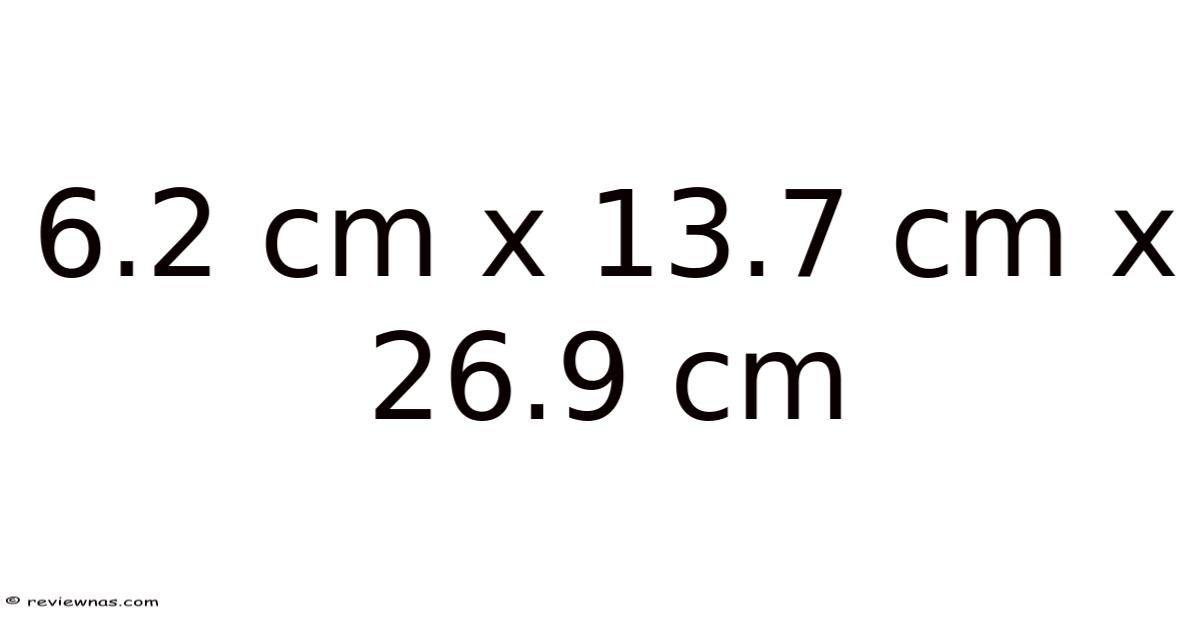
You’re standing in the middle of a cluttered room, holding a small rectangular object, and the numbers on the box stare back at you: 6.Why does this specific set of measurements matter? Suddenly the everyday feels a little mysterious. 7 cm x 26.Also, 2 cm x 13. What can you actually do with them? Think about it: 9 cm. Let’s peel back the layers and see why these dimensions deserve a closer look.
What Is 6.2 cm x 13.7 cm x 26.9 cm
The Physical Shape
Imagine a shallow box that’s a bit longer than it is wide, with a depth that sneaks up on you. The first number, 6.Worth adding: 2 cm, is the width – the side you’d measure across the front. On top of that, the second, 13. 7 cm, is the height – the vertical edge you’d see when the object stands upright. The last, 26.9 cm, is the depth – the dimension that tells you how far it stretches back. Together they describe a three‑dimensional rectangle, the kind you’d find in a picture frame, a small storage container, or even a compact electronic device.
Typical Uses
You’ll often run into these dimensions when dealing with items that need to fit snugly into a limited space. 9 cm means you can store a few books, a tablet, or a small laptop without the whole thing bulging out. 7 cm tall can slide under an airplane seat without a fuss. And a depth of 26.A picture frame with a 6.2 cm width can hold a 5 × 7 inch photo with a little breathing room. Worth adding: a compact travel case that measures 13. In practice, the combination of width, height, and depth tells you whether something will fit on a shelf, slide into a bag, or survive a shipping label The details matter here. Less friction, more output..
Why It Matters / Why People Care
Real‑World Scenarios
Think about a photographer who wants to ship a framed print. In real terms, if the frame’s dimensions don’t match the box they’re using, the item could shift, get scratched, or even break. And knowing that 6. 2 cm x 13.Plus, 7 cm x 26. 9 cm is the exact size of a standard 8 × 10 inch frame (plus a thin border) helps them pick the right packaging and avoid costly returns Worth keeping that in mind. But it adds up..
Or picture a student packing a backpack for a semester abroad. A case that’s 13.7 cm tall fits neatly beside a water bottle, while a depth of 26.9 cm allows a slim laptop to sit flat without adding bulk. In these everyday moments, the numbers become a silent guide that keeps things organized, protects valuables, and saves time Still holds up..
The official docs gloss over this. That's a mistake Worth keeping that in mind..
The Cost of Getting It Wrong
When dimensions are off, the consequences can be surprisingly costly. A frame that’s too shallow might force the glass to
press against the photo, risking cracks. A storage box with miscalculated depth could leave gaps, letting items rattle and chip during transit. Even a slight error—like assuming 26.Day to day, precision isn’t just about fitting; it’s about trust. 9 cm is “close enough” to 27 cm—might result in a shipment being rejected at customs or a product failing safety inspections. Manufacturers, retailers, and consumers all rely on exact measurements to avoid waste, delays, or damage.
The Hidden Precision Behind the Numbers
These dimensions aren’t arbitrary. They’re engineered to balance functionality and efficiency. The width of 6.2 cm accommodates standard paper sizes (like A4 or letter) with a margin for protective sleeves, while the height of 13.7 cm aligns with ergonomic handling—easy to grip yet compact enough for tight spaces. The depth of 26.9 cm, though seemingly modest, allows for layered storage: a stack of CDs, a folded map, or a charging cable coiled neatly. Such ratios reflect decades of optimization, ensuring compatibility with everything from shipping containers to retail displays.
A Universal Language
Measurements like these transcend language and culture. A 6.2 cm x 13.7 cm x 26.9 cm box speaks the same language to a warehouse manager in Tokyo as it does to a student in Paris. They’re a shorthand for compatibility, a guarantee that two strangers separated by oceans can agree on whether a package will fit. This universality is why standardized dimensions underpin global trade, from electronics packaging to furniture assembly. Without them, logistics would crumble into chaos Worth keeping that in mind..
The Final Measure
So, why do these numbers matter? Because they turn abstraction into action. They’re the difference between a gift wrapped securely and one that arrives shattered, between a device that powers your day and one that overheats in a poorly ventilated box. The next time you encounter 6.2 cm x 13.7 cm x 26.9 cm, remember: it’s more than a specification. It’s a promise of fit, a blueprint for efficiency, and a testament to how even the smallest details shape our interconnected world. In a universe of infinite possibilities, these dimensions remind us that sometimes, the right size is everything Worth knowing..
Turning Numbers Into Action: How to Verify Your Measurements
Even the most well‑designed specification can fall apart if the numbers never reach the bench or the shipping dock. That’s why a small, systematic approach to measuring and documenting dimensions is essential for anyone who relies on precision That's the whole idea..
-
Use calibrated tools – A digital caliper or a high‑accuracy ruler should be checked against a national standard before each use. Even a 0.1 mm error can ripple into a 26.9 cm depth misfit.
-
Measure at multiple points – For irregular shapes, take readings at the widest, tallest, and deepest spots. Record each value and calculate an average; this guards against local anomalies It's one of those things that adds up..
-
Document with context – Attach a photo of the specimen, note the ambient temperature, and record the tool’s serial number. A simple spreadsheet can keep all of this data in one place, making it easy to audit later.
-
Apply tolerances – Industry standards often provide acceptable tolerances (e.g., ±0.2 mm). When you’re designing a revenues‑critical component, use the worst‑case tolerance to ensure the part will still function under all conditions.
-
Cross‑check with the supplier’s data – If you’re sourcing a component, compare the manufacturer’s datasheet against your own measurements. A discrepancy can flag a counterfeit or a re‑labeling error before it reaches the customer.
Adopting these habits turns the abstract numbers of a datasheet into a living, breathing guarantee of quality The details matter here..
The Ripple Effect of Precision
When a single dimension is off, the impact can cascade. Still, a mis‑sized shipping box can cause a product to shift, which might trigger a crash test failure for a vehicle component or lead to a costly recall for consumer electronics. Looking at it differently, precision engineering can reach new efficiencies: a tighter fit means less packing material, lower shipping costs, and a smaller environmental footprint Less friction, more output..
Consider the case of a medical device manufacturer that tightened the tolerance on a syringe’s barrel successive by just 0.05 mm. The result? A 25 % reduction in material waste and a 15 % drop in shipping weight, translating into millions saved annually while maintaining patient safety.
Looking Ahead: Smart Measurement
The future of dimensional accuracy is increasingly digital. 3‑D scanners and laser profilometers can capture the geometry of a part in seconds, feeding the data directly into a computer‑aided design (CAD) model. Coupled with machine‑learning algorithms, these tools can predict where a component is likely to fail and suggest a design tweak before a prototype is even built.
In an era where supply chains are more global and products more complex, the ability to measure accurately and act on that data is no longer a luxury—it’s a strategic necessity Not complicated — just consistent..
Conclusion
Numbers like 6.In practice, 7 cm × 26. Day to day, 2 cm × 13. 9 cm are more than mere coordinates on a sheet of paper; they are the silent architects of our everyday interactions. Whether you’re a hobbyist packing a gift, a warehouse manager routing inventory, or an engineer designing the next generation of consumer devices, precision in measurement is the common thread that keeps everything running smoothly.
The next time you see a set of dimensions, remember that behind those digits lies a story of careful calibration, thoughtful design, and a commitment to reliability. In a world that constantly demands more speed, more efficiency, and more safety, embracing precise measurement is the most reliable way to see to it that every part, product, and package fits exactly where it should—without compromise.
