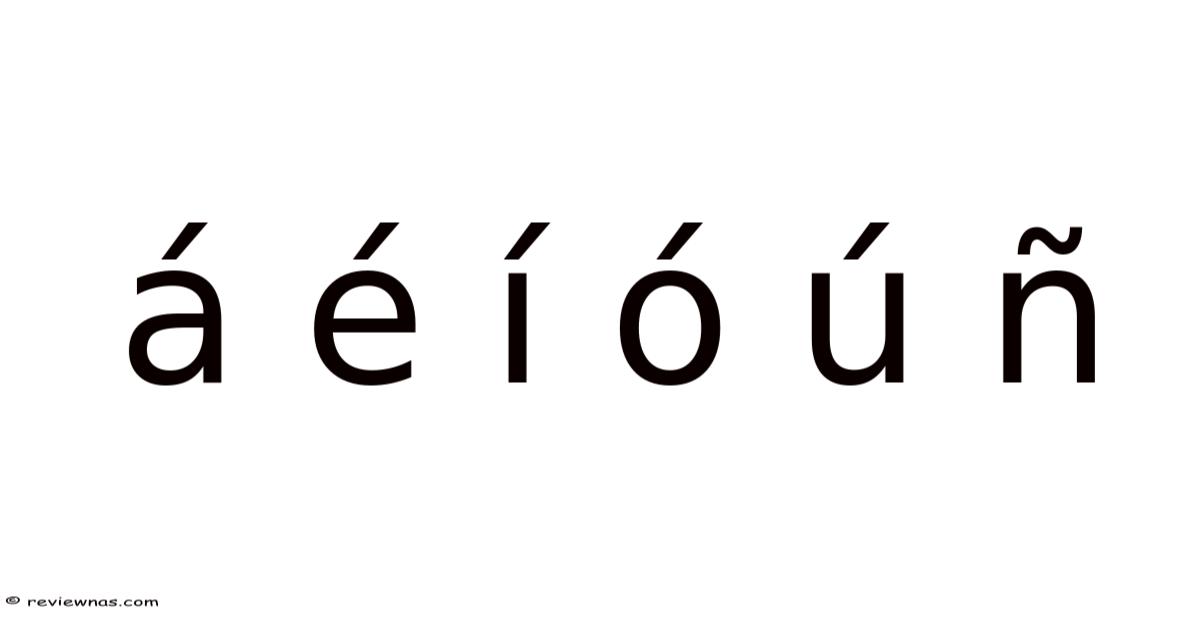
If you’ve ever stared at a keyboard wondering how to type á é í ó ú ñ, you’re not alone. So those little marks might look like decoration, but they carry weight in Spanish and other languages. In this guide we’ll unpack what they are, why they matter, and how you can type them without pulling your hair out And that's really what it comes down to..
What Is á é í ó ú ñ
The Basics of Spanish Accents
The characters á é í ó ú ñ are part of the extended Latin alphabet used in Spanish and a few other languages. They’re not separate letters; they’re the same letters you already know, just with a mark added to change sound or meaning. Think of an accent as a tiny flag that tells your ear (or your spell‑check) how a word should be pronounced.
When you see á, you’re looking at an “a” with an acute accent. The same goes for é, í, ó, ú. That flag usually means the vowel is stressed, and it can change the word’s meaning entirely. The ñ is a whole different beast: it’s an “n” with a tilde, and it’s the only letter that has its own name in Spanish — “eñe.
How Accents Change Pronunciation and Meaning
Accents aren’t just decorative; they’re functional. In Spanish, the word “el” (the) without an accent is a definite article, while “él” (he) has an accent to show it’s a pronoun. Without that mark, you could end up saying “el” when you meant “él,” which could lead to some funny misunderstandings Easy to understand, harder to ignore..
Most guides skip this. Don't.
The same principle applies to ó and ú. A tiny mark can flip the whole sentence. And ñ? “ó” can be a verb form (“he/she sees”) while “o” is a conjunction (“or”). It’s the only letter that doesn’t exist in English, so when you type “canyon” you’re actually using “ñ” in the Spanish version “cañón.
Why It Matters
Why should you care about these little symbols? Because they’re the difference between “I love you” and “I love you” with a typo that changes the whole phrase. In a global world, getting the spelling right shows respect for the language and its speakers.
If you’re learning Spanish, mastering these accents early can save you from a lot of back‑and‑forth with native speakers. They’ll notice when you get them right, and that tiny nod of approval can boost your confidence.
Even if you’re not learning Spanish, you might encounter these characters in names, brands, or technical terms. And a misspelled “café” versus “cafe” could affect a menu, a logo, or a search engine result. In practice, the right accent can improve SEO, because search engines treat “café” and “cafe” as separate queries That's the whole idea..
How It Works (or How to Do It)
Keyboard Shortcuts for Windows
On a Windows PC, there are a few reliable ways to type á é í ó ú ñ. The most straightforward is using the Alt code method. Hold down the Alt key and type the four‑digit number on the numeric keypad. Here's one way to look at it: Alt 0225 gives you “á,” while Alt 0233 produces “é.” The trick is to make sure Num Lock is on and that you use the numeric keypad, not the numbers above the letters Worth knowing..
If you prefer a more visual approach, the Character Map app can help. So open it by searching “Character Map” in the Start menu, scroll to the “ñ” section, and double‑click the character you need. It will copy the character to your clipboard, ready to paste wherever you like And that's really what it comes down to..
Keyboard Shortcuts for Mac
Mac users have a built‑in option called the Option key. Even so, press Option + e, then type “a” to get “á. ” For “é,” it’s Option + e followed by “e.” The pattern continues: Option + i gives “í,” Option + o gives “ó,” and Option + u gives “ú.” The ñ is Option + n, then “n” again.
If you’re using a newer MacBook with a Touch Bar, you can also press and hold the “n” key to bring up a small popup that lets you choose “ñ” without the extra key combo Not complicated — just consistent..
Mobile Devices and Virtual Keyboards
On iOS and Android, the process is even simpler. In iOS, tap and hold the “a” key, and a popup will appear with “á,” “à,” “â,” “ä,” and “ã.” Slide your finger to “á.” The same trick works for “e,” “i,” “o,” and “u.That said, most virtual keyboards have a hidden “á é í ó ú ñ” layer. ” For “ñ,” press and hold the “n” key and look for the “ñ” option Simple, but easy to overlook. And it works..
If you use a third‑party keyboard app, check its settings. Many allow you to enable a dedicated “ñ” key or a shortcut that brings up the accented characters without long‑pressing No workaround needed..
Common Errors When Typing Accents
Even with the right tools, mistakes happen. A frequent error is typing “a” instead of “á” and then trying to add the accent later, which can corrupt the character. Another pitfall is using the wrong keyboard layout — if your system is set to a US layout, the Alt codes might not work as expected.
Not obvious, but once you see it — you'll see it everywhere Not complicated — just consistent..
Also, copying and pasting from a website can sometimes bring hidden formatting that turns “á” into a weird symbol. Always double‑check the character after pasting.
Common Mistakes / What Most People Get Wrong
One big misconception is that accents are optional. On the flip side, in Spanish, they’re mandatory in many cases, and dropping them can change a word’s meaning or make it unrecognizable. Take this case: “el” versus “él” isn’t just a style choice; it’s a grammatical necessity.
Another mistake is assuming that all languages use the same accent rules. Here's the thing — while Spanish uses acute accents (´) and the tilde (~) on ñ, French uses accents like ç and ô, and Portuguese uses á, é, í, ó, ú, â, ã, õ. Mixing them up can lead to confusion, especially when you’re typing quickly.
People also tend to overlook the importance of consistency. If you type “café” in one place and “cafe” elsewhere, search engines may treat them as different terms, hurting your SEO. Consistency matters, whether you’re writing a blog post or labeling a product Surprisingly effective..
You'll probably want to bookmark this section.
Practical Tips / What Actually Works
Here’s what really works when you need to type á é í ó ú ñ without fuss:
- Memorize the shortcut patterns – On Windows, Alt codes; on Mac, the Option key combos. A quick mental cue can save you a lot of time.
- Use a cheat sheet – Keep a small note on your desk or a sticky note on your monitor with the most common combos. It’s a low‑effort reminder that pays off.
- Enable auto‑correct for frequent words – If you often type “café,” set up an auto‑replace rule that turns “cafe” into “café.” This reduces the chance of error.
- Practice with real sentences – Instead of typing isolated letters, write short phrases like “El niño está en el café.” The context helps your muscle memory.
- Check with a spell‑checker – Most modern spell‑checkers flag missing accents. If a word is underlined, take a moment to add the correct mark.
FAQ
What’s the difference between á and a?
The acute accent on “á” signals that the vowel is stressed and changes the pronunciation. Without it, “a” is just a plain vowel.
Can I type ñ on a standard US keyboard?
Yes, by using Alt codes (Alt 0241) or by enabling a Spanish layout.
Do other languages use these same characters?
Many languages use acute accents, but the tilde on “ñ” is unique to Spanish and a few other languages like Galician.
Is there a way to see all accented characters at once?
Absolutely. On Windows, the Character Map; on Mac, the Special Characters panel; on mobile, the long‑press method on the keyboard Less friction, more output..
Why is “ñ” considered a separate letter?
Historically, “ñ” evolved from “n” followed by “i,” and it represents a distinct sound that doesn’t exist in English. Because it’s a separate phoneme, it gets its own place in the alphabet.
Closing paragraph
Mastering á é í ó ú ñ isn’t about memorizing a list of shortcuts; it’s about understanding why those marks matter and how they shape communication. When you take the time to type them correctly, you honor the language, improve clarity, and avoid the kind of mix‑ups that can lead to confusion. So next time you sit down at your computer, remember the little flags that give words their true voice, and let those accents do the work for you.
