The Surprising Truth About What Holds Your Genetic Blueprint
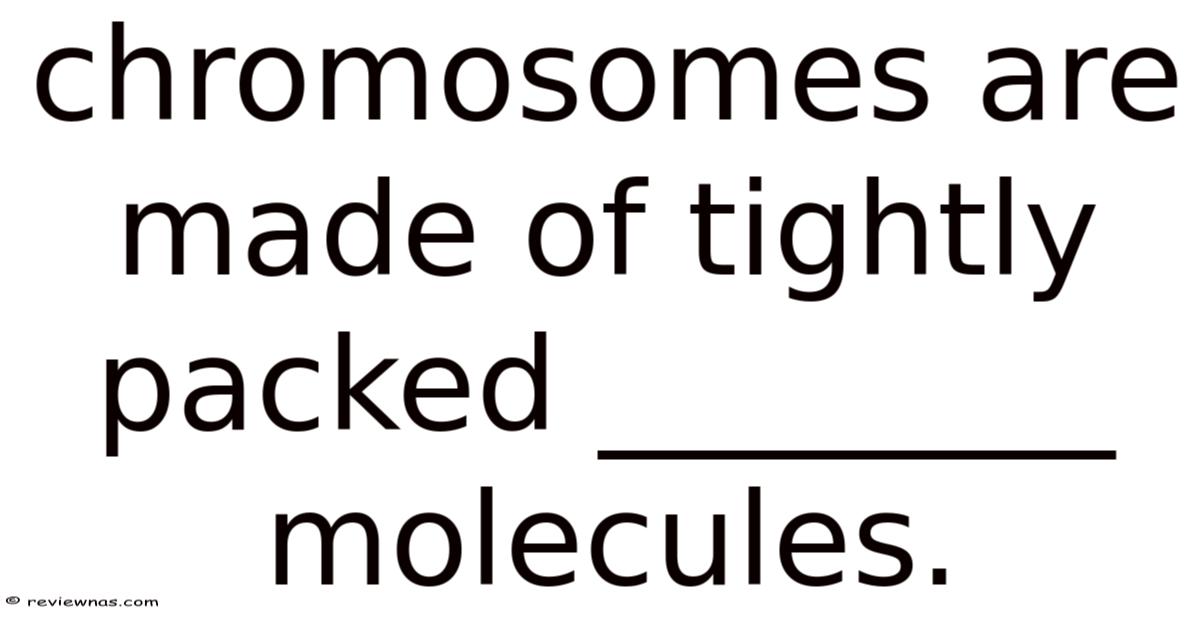
You’ve probably stared at a microscope image of a cell and wondered how something so tiny can pack an entire instruction manual for life. So the answer to the classic fill‑in‑the‑blank question “chromosomes are made of tightly packed ________ molecules” is not a single word you can scribble on a flashcard. In practice, it’s a dynamic duo of DNA and protein, working together in a dance that’s been honed over billions of years. It’s not just a jumble of strands; it’s a highly organized structure that fits inside a nucleus smaller than a speck of dust. Let’s unpack that dance, see why it matters, and discover the practical takeaways that actually help you understand genetics, health, and even everyday biology Most people skip this — try not to..
What Are Chromosomes, Really
At first glance, chromosomes look like X‑shaped blobs when you catch them during cell division. But that X‑shape is a snapshot of a much more complex reality. Consider this: in the interphase of the cell cycle, when the DNA is not being copied, chromosomes de‑condense into a diffuse material called chromatin. When the cell prepares to divide, that same chromatin folds, twists, and supercoils until it becomes the visible chromosome Worth keeping that in mind. Less friction, more output..
The Core Components
- DNA: The long, ladder‑like molecule that carries the sequence of nucleotides—adenine, thymine, cytosine, and guanine. This is the actual code that tells cells which proteins to make.
- Histone proteins: Spools around which DNA winds. Think of them as the protein “nails” that hold the DNA thread in place as it’s wound tighter and tighter.
When you combine these two, you get a substance called chromatin. Practically speaking, in its most compact form, chromatin is what we call a chromosome. So, the blank in the original question is best filled with “DNA‑protein complexes” or simply “DNA and protein molecules.
Why the Blank Matters
If you think of a chromosome as a book, DNA is the story, and histones are the binding that keeps the pages together. Think about it: without the binding, the story would be a tangled mess on the floor. With it, the story stays organized, readable, and ready for the cell to flip to the right page when needed But it adds up..
Why This Matters to You
You might wonder, “Why should I care about chromosomes being tightly packed DNA molecules?” The answer is simple: everything from inherited traits to disease risk hinges on how that DNA is packaged.
- Gene regulation: Tightly packed regions (called heterochromatin) are usually silent—genes there are turned off. Looser regions (euchromatin) are active, allowing genes to be expressed.
- Mutation susceptibility: Certain parts of the genome are more exposed than others. If you’re exposed to radiation or chemicals, those exposed regions are more likely to suffer damage.
- Medical diagnostics: Many cancers are linked to abnormal chromosome structures—think of the Philadelphia chromosome in chronic myeloid leukemia. Understanding the packaging helps doctors predict how a tumor might behave.
In short, the way chromosomes are built influences how your body works, how it fights disease, and how scientists develop new therapies.
How It Works: The Mechanics of Packing
Let’s dive into the step‑by‑step process that turns a long DNA strand into a compact chromosome.
The DNA Backbone
DNA is a polymer made of nucleotides linked together in a repeating pattern of sugar, phosphate, and a nitrogenous base. Because of that, this backbone is negatively charged, which makes it repel other negatively charged molecules. That repulsion is a key reason why DNA needs proteins to keep it from falling apart.
Histone Proteins: The Molecular Spools
Histones come in several flavors—H1, H2A, H2B, H3, and H4 are the most common. Plus, the core particle consists of an octamer made of two copies each of H2A, H2B, H3, and H4. DNA wraps around this octamer about 1.75 times, forming a “bead‑on‑a‑string” structure. Each bead is called a nucleosome No workaround needed..
From Nucleosomes to Chromatin
Once DNA is wound around nucleosomes, the beads can slide past each other, allowing the DNA to be further compacted. Additional layers of folding involve the formation of a 30‑nanometer fiber, which then coils into loops. These loops attach to a scaffold of additional proteins, creating a structure that can be seen under a microscope as a chromosome during mitosis.
The Role of Non‑Histone Proteins
Not all the proteins involved are histones. Cohesin, condensin, and other structural maintenance of chromosomes (SMC) complexes help hold loops together and check that each daughter cell receives an exact copy of the genome.
Visualizing the Packing
Imagine a long piece of yarn (DNA) that you want to fit into a tiny box (the nucleus). First, you wrap the yarn around a series of small spools (nucleosomes). Then you stack those spools together, tie them with additional strings (non‑histone proteins), and finally fold the whole thing into
This changes depending on context. Keep that in mind.
the nucleus. During interphase, this arrangement allows controlled access: proteins can unzip specific regions to read genes, while the rest remains safely tucked away. When the cell prepares to divide, the chromatin undergoes dramatic reorganization. Condensin enzymes further tighten the coils, making chromosomes visible as distinct X-shaped structures—each sister chromatid joined at the centromere.
Some disagree here. Fair enough.
This precise architecture isn’t just about space-saving. It’s essential for accurate cell division. During mitosis, sister chromatids must separate cleanly; any missteps in packing can lead to broken or misshapen chromosomes, risking developmental disorders or cancer. Similarly, in meiosis, proper chromosome structure ensures genetic material is distributed evenly to offspring.
Regulation and Flexibility
Chromosome packing isn’t a static prison—it’s highly dynamic. Consider this: cells can loosen or tighten chromatin depending on which genes need to be accessed. To give you an idea, during embryonic development, entire regions of chromosomes swing open to activate stem cell genes, then re-pack tightly as cells specialize. This flexibility is orchestrated by chemical tags—like methyl groups or acetyl groups—that stick to histones, signaling whether nearby DNA should be open or closed Surprisingly effective..
These epigenetic marks don’t alter the DNA sequence itself, but they can be inherited by daughter cells, influencing everything from metabolism to mental health. In recent years, therapies targeting these modifications—such as histone deacetylase inhibitors—have shown promise in treating certain cancers by reawakening tumor suppressor genes silenced through excessive chromatin condensation But it adds up..
Conclusion
From the moment a single fertilized egg begins to develop, chromosome structure is hard at work. It governs which genes are heard and which remain silent, how DNA withstands daily wear and tear, and how faithfully genetic information passes from one generation of cells to the next. By understanding how histones, proteins, and chemical tags shape the genome’s physical form, researchers are unlocking new ways to diagnose disease, target therapies, and even edit genes with unprecedented precision. In essence, the chromosome’s architecture is not just a marvel of molecular engineering—it’s a blueprint for life itself.
Emerging Frontiers: From Mapping to Manipulation
The past decade has witnessed an explosion of tools that let scientists peer inside the chromatin landscape with a resolution that was unimaginable a few years ago. Chromatin immunoprecipitation followed by sequencing (ChIP‑seq) now charts the occupancy of every histone modification across the genome, while single‑molecule techniques such as optical tweezers and cryo‑EM reveal the mechanical forces that hold each loop in place. Hi‑C and its derivatives map three‑dimensional contacts, exposing how distant enhancers meet their target promoters and how entire chromosomes fold into territories that are remarkably consistent across cell types yet flexible enough to accommodate developmental cues Nothing fancy..
These high‑resolution maps have uncovered a surprising level of heterogeneity: two cells of the same lineage can display subtly different folding patterns, reflecting the stochastic nature of transcription and the influence of environmental signals. Also worth noting, long‑range interactions are not static; they can be rewired in response to stress, metabolic changes, or pharmacological agents. To give you an idea, exposure to certain drugs can induce a global relaxation of chromatin, allowing otherwise silenced genes to become expressed—a phenomenon that underlies some of the side‑effects observed in epigenetic therapies.
Therapeutic Horizons: Turning Chromatin Knowledge into Medicine
The ability to modulate chromatin architecture has already birthed a new class of drugs known as epigenetic modulators. In practice, histone deacetylase (HDAC) inhibitors, bromodomain and extra‑terminal (BET) bromodomain inhibitors, and DNA methyltransferase inhibitors each target a specific node in the chromatin regulatory network, effectively “re‑tuning” gene expression without altering the underlying DNA code. While these agents have shown efficacy in hematologic malignancies, ongoing research aims to expand their utility to solid tumors, neurodegenerative diseases, and even neuropsychiatric conditions where aberrant gene regulation plays a central role Easy to understand, harder to ignore..
Beyond small molecules, genome‑editing platforms such as CRISPR‑Cas systems are being repurposed to rewrite epigenetic marks directly. So catalytically dead Cas9 fused to histone acetyltransferases or methyltransferases can be guided to specific loci to open or close chromatin in a programmable fashion. Early proof‑of‑concept studies demonstrate that such “epigenome editing” can reactivate dormant tumor suppressor genes or silence oncogenic enhancers, offering a more precise alternative to traditional gene knockout approaches Nothing fancy..
Evolutionary Insights: Why Chromatin Is a Master of Economy
From an evolutionary perspective, the compactness of chromatin solves a fundamental problem: how to pack two meters of genetic material into a nucleus that is only about 10 µm across while still preserving the ability to access any of its 20,000‑plus genes on demand. This economy of space is mirrored in the conservation of histone proteins across eukaryotes—from yeast to humans—underscoring that the basic folding principle predates the diversification of multicellular life. Yet, the added layers of regulation—non‑histone proteins, higher‑order loops, and epigenetic marks—have been co‑opted to meet the demands of complex development, tissue specialization, and environmental adaptation It's one of those things that adds up..
The flexibility of chromatin architecture also explains why genome size does not always correlate with organismal complexity. Organisms with far larger genomes than humans, such as certain salamanders or lungfishes, achieve a similar level of gene regulation through sophisticated folding strategies and abundant non‑coding regulatory elements. In this view, the genome is less a static script and more a dynamic scaffold that can be reshaped in response to physiological needs That alone is useful..
Looking Ahead: From Understanding to Engineering
The next frontier lies in integrating multi‑scale data—from the atomic details of nucleosome positioning to whole‑chromosome territories—into predictive models that can forecast how a given perturbation will remodel the chromatin landscape. Machine‑learning algorithms trained on massive epigenomic datasets are already beginning to suggest design rules for synthetic promoters that harness favorable folding patterns, or for gene‑therapy vectors that evade unwanted silencing.
When all is said and done, the story of chromosome structure is a reminder that the genome is not merely a collection of genes but a living, breathing entity whose physical form governs its function. By deciphering the rules of this three‑dimensional code, scientists are poised to rewrite the narrative of disease, open up hidden capacities of the human body, and perhaps, one day, engineer novel biological systems with unprecedented precision. In this ever‑evolving dialogue between structure and information, the chromosome remains both the stage and the scriptwriter, shaping the drama of life one loop at a time.
