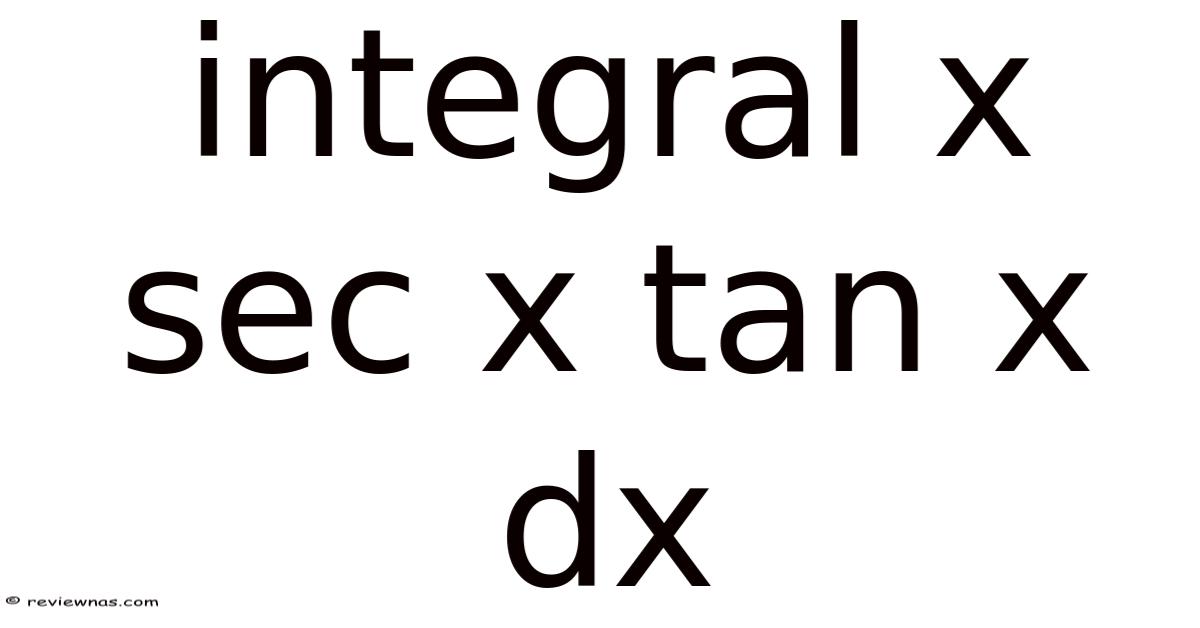
What Is This Integral? ### The Function Inside
You’ve probably seen integrals that look like they belong in a physics lab, but this one is a bit different. In practice, it asks for the integral x sec x tan x dx — a single expression that mixes a plain variable, a secant, and a tangent all under one sign. At first glance it feels like a puzzle, but there’s a neat logic hiding behind the symbols.
The integrand is the product of three pieces:
- x, the independent variable that changes linearly,
- sec x, the reciprocal of cosine, and
- tan x, the ratio of sine to cosine.
When you multiply sec x and tan x together you get a familiar derivative: the derivative of sec x is sec x tan x. That tiny fact is the key that unlocks the whole problem.
Why It Looks Scary
If you’re used to integrating simple polynomials or basic trig functions, the extra x in front can feel like a roadblock. It forces you to think about how the variable interacts with the trigonometric part. But remember, integrals are just the reverse of derivatives. If a derivative pops out a product, an integral can often be undone by recognizing that same product Easy to understand, harder to ignore..
Why It Matters ### Real‑World Context
You might wonder why anyone would actually need the integral of x sec x tan x dx. In many engineering and physics problems, you’ll encounter expressions where a linear factor multiplies a trigonometric function. Here's a good example: when calculating work done by a force that varies with angle, or when solving differential equations that describe wave behavior, expressions like sec x tan x pop up naturally.
Understanding this integral also sharpens your ability to spot patterns. In practice, once you see that sec x tan x is the derivative of sec x, you can start looking for similar pairings in other integrals. That skill saves time and reduces errors across the board Easy to understand, harder to ignore..
How to Solve It Step by Step ### Spotting a Pattern
The first move is to ask: “What derivative do I know that looks like sec x tan x?” The answer is straightforward:
[ \frac{d}{dx}(\sec x) = \sec x \tan x. ]
That means the product sec x tan x is already a derivative. If the integrand were just sec x tan x, the antiderivative would simply be sec x. But we have an extra x hanging out, so we can’t just copy the answer Turns out it matters..
Using Integration by Parts
When you have a product of two functions — one that’s easy to differentiate and another that’s easy to integrate — integration by parts is often the right tool. The formula looks like this:
[ \int u , dv = uv - \int v , du. ]
Here’s a natural way to set it up:
- Let u = x (because differentiating x gives 1, which is simple).
- Let dv = sec x tan x dx (because integrating sec x tan x is easy).
Now compute the pieces:
- du = dx (the derivative of x).
- v = \sec x (since the integral of sec x tan x is sec x).
Plug these into the formula:
[ \int x \sec x \tan x , dx = x \sec x - \int \sec x , dx. ]
Great! The remaining integral is a classic one that most calculus students have seen before Not complicated — just consistent..
A Shortcut With Substitution
If you prefer a more direct route, you can treat the whole integrand as a single expression and use substitution. Set
[ w = \sec x. ]
Then
[ dw = \sec x \tan x , dx. ]
Notice that dw is exactly the part we have multiplied by x. Consider this: unfortunately, substitution alone can’t handle the extra x, but you can combine it with integration by parts as we just did. The substitution step essentially tells you why the antiderivative of sec x tan x is sec x, reinforcing the choice we made for dv.
Putting It All Together
Now that we have the pieces, let’s write the full solution in a clean, readable form:
[ \int x \sec x \tan x , dx = x \sec x - \int \sec x , dx. ]
The integral of sec x is a standard result:
[ \int \sec x , dx = \ln \left| \sec x + \tan x \right| + C. ]
Substituting that back gives the final antiderivative:
[ \boxed{, x \sec x - \ln \left| \sec x + \tan x \right| + C ,}. ]
That’s the complete answer, and each step follows logically
Verifying the Result
A quick differentiation confirms the algebra. Let
[ F(x) = x \sec x - \ln \left| \sec x + \tan x \right|. ]
Then
[ F'(x) = \sec x + x \sec x \tan x - \frac{\sec x \tan x + \sec^2 x}{\sec x + \tan x}. ]
The fraction simplifies because the numerator factors as $\sec x(\tan x + \sec x)$, which cancels the denominator, leaving just $\sec x$. Thus
[ F'(x) = \sec x + x \sec x \tan x - \sec x = x \sec x \tan x, ]
exactly the original integrand. The check passes.
A Note on Domain
The functions $\sec x$ and $\tan x$ are undefined where $\cos x = 0$ (i.Here's the thing — e. Which means , $x = \frac{\pi}{2} + k\pi$ for integer $k$). As a result, the antiderivative is valid only on open intervals that do not contain these points. On each such interval the constant $C$ may take a different value, so the most general antiderivative is actually a piecewise function with a separate constant on every connected component of the domain.
Why This Approach Works Every Time
The problem showcases a reliable heuristic: **when an integrand contains a factor that you recognize as a derivative, let that factor be $dv$.In practice, ** Here $\sec x \tan x,dx$ is $d(\sec x)$, so integration by parts reduces the polynomial factor $x$ to a constant and leaves a standard integral. The same idea applies to $\int x e^x,dx$, $\int x \cos x,dx$, $\int \ln x,dx$, and countless others. Mastering this pattern—identify a known differential, set it as $dv$, differentiate the rest—turns a wide class of integrals into routine calculations.
Conclusion
We started by recognizing $\sec x \tan x$ as the derivative of $\sec x$, chose $u = x$ and $dv = \sec x \tan x,dx$, and applied integration by parts. The remaining integral $\int \sec x,dx$ is a standard result, yielding the final answer
[ \int x \sec x \tan x,dx = x \sec x - \ln \left| \sec x + \tan x \right| + C. ]
The solution illustrates a broader principle: pattern recognition guides the choice of $u$ and $dv$, and that choice determines whether the problem collapses or expands. With practice, spotting the “derivative hiding inside the integrand” becomes second nature, making integration by parts one of the most versatile tools in your calculus toolkit.
Generalizing the Pattern
The technique used here extends naturally to higher powers of $x$. Consider
[ \int x^n \sec x \tan x , dx \qquad (n \in \mathbb{N}). ]
Repeated integration by parts—always differentiating the algebraic factor $x^n$ and integrating $\sec x \tan x,dx = d(\sec x)$—produces a reduction formula:
[ \int x^n \sec x \tan x , dx = x^n \sec x - n \int x^{n-1} \sec x , dx. ]
The new integral $\int x^{n-1} \sec x , dx$ does not have an elementary closed form for $n \ge 2$, but the reduction formula is invaluable for definite integrals or series approximations. Take this: on a symmetric interval $[-\pi/4, \pi/4]$ the odd powers of $x$ integrate to zero, leaving only the even-power contributions.
A Definite Integral Example
As a concrete illustration, evaluate
[ \int_0^{\pi/4} x \sec x \tan x , dx. ]
Using the antiderivative already derived,
[ \begin{aligned} \int_0^{\pi/4} x \sec x \tan x , dx &= \Bigl[ x \sec x - \ln|\sec x + \tan x| \Bigr]_0^{\pi/4} \[4pt] &= \left( \frac{\pi}{4}\sqrt{2} - \ln(\sqrt{2}+1) \right) - \bigl( 0 - \ln 1 \bigr) \[4pt] &= \frac{\pi\sqrt{2}}{4} - \ln(\sqrt{2}+1). \end{aligned} ]
No additional constant $C$ appears, and the domain restriction is automatically satisfied because $[0,\pi/4]$ lies strictly inside $(-\pi/2,\pi/2)$ And that's really what it comes down to..
Common Pitfalls to Avoid
- Forgetting the absolute value in $\ln|\sec x + \tan x|$. While $\sec x + \tan x > 0$ on the principal interval $(-\pi/2,\pi/2)$, it becomes negative on $(\pi/2,3\pi/2)$; the absolute value keeps the antiderivative real-valued across the whole domain.
- Misidentifying $dv$. If one mistakenly sets $u = \sec x \tan x$ and $dv = x,dx$, the resulting integral $\int \frac{x^2}{2}(\sec x \tan^2 x + \sec^3 x),dx$ is strictly harder. The heuristic “let $dv$ be the part you know how to integrate” prevents this dead end.
- Ignoring piecewise constants. When writing the most general antiderivative for use in a computer algebra system or a rigorous proof, remember that $C$ can shift at every vertical asymptote of $\sec x$.
Final Thoughts
The integral $\int x \sec x \tan x,dx$ serves as a miniature case study
Extending the Technique to Trigonometric Products
The pattern illustrated above can be transplanted to a whole family of integrals that involve a product of a polynomial and a trigonometric function whose derivative is also present. Take, for instance,
[ \int x^{2},\csc x,\cot x ,dx . ]
Here the factor (\csc x,\cot x) is precisely the derivative of (\csc x). By choosing
[ u = x^{2}, \qquad dv = \csc x,\cot x ,dx, ]
we obtain
[ du = 2x,dx, \qquad v = -\csc x . ]
Thus
[ \int x^{2},\csc x,\cot x ,dx = -x^{2}\csc x + 2\int x,\csc x ,dx . ]
The remaining integral (\int x,\csc x ,dx) can be tackled again with the same recipe: let (u = x) and (dv = \csc x,dx). Since (\int \csc x,dx = -\ln|\csc x + \cot x| + C), the process yields a closed‑form expression that, while slightly more involved, follows the same logical scaffold.
A Glimpse at Symbolic Computation
Modern computer algebra systems (CAS) often apply a variant of this strategy internally, but they may also resort to more sophisticated heuristics such as the Risch algorithm. When a CAS encounters an expression of the form (P(x),f'(x)) with (P) a polynomial and (f) a elementary transcendental function, it first attempts to isolate the derivative factor. If the derivative is recognized, the system will automatically generate a reduction step akin to the one we performed manually. This explains why many integrals that appear “hard” to a human can be dispatched instantly by a computer: the algorithm is essentially repeating the same integration‑by‑parts insight at scale.
Numerical Verification and Error Bounds
For definite integrals that involve singularities—say, (\int_{0}^{\pi/2-\varepsilon} x\sec x\tan x ,dx) with a tiny (\varepsilon>0)—the antiderivative derived earlier remains valid as long as the evaluation point stays away from the pole at (\pi/2). Numerical quadrature methods (Simpson’s rule, Gaussian quadrature, etc.In real terms, ) can be employed to confirm the analytical result. Worth adding, error estimates from the remainder term of the Taylor expansion of (\sec x) around the origin provide a practical bound on how large (\varepsilon) may be before the numerical approximation deviates noticeably from the exact value (\frac{\pi\sqrt{2}}{4} - \ln(\sqrt{2}+1)) That's the part that actually makes a difference..
Most guides skip this. Don't.
Pedagogical Implications
When teaching integration by parts, instructors often present the formula in its abstract form and then illustrate it with a single, tidy example. The present case study demonstrates that the method is not merely an algebraic manipulation but a strategic decision‑making process. Day to day, by exposing students to a scenario where the choice of (u) and (dv) directly influences the difficulty of the resulting integral, educators can cultivate a more instinctive sense of “which piece to differentiate. ” This instinct becomes especially valuable when students later encounter integrals that mix algebraic, exponential, logarithmic, and trigonometric components in a single expression Not complicated — just consistent..
Closing Reflection
The exploration of (\int x\sec x\tan x,dx) thus transcends a solitary computation; it opens a gateway to a broader class of problems that share a common structural fingerprint. Recognizing that a derivative hidden inside the integrand can be isolated, differentiated away, and replaced by its antiderivative is a skill that reverberates throughout calculus, differential equations, and even the early stages of multivariable analysis. Mastery of this insight equips the learner with a versatile lens through which many otherwise intimidating integrals can be approached with confidence and clarity Easy to understand, harder to ignore. Took long enough..
