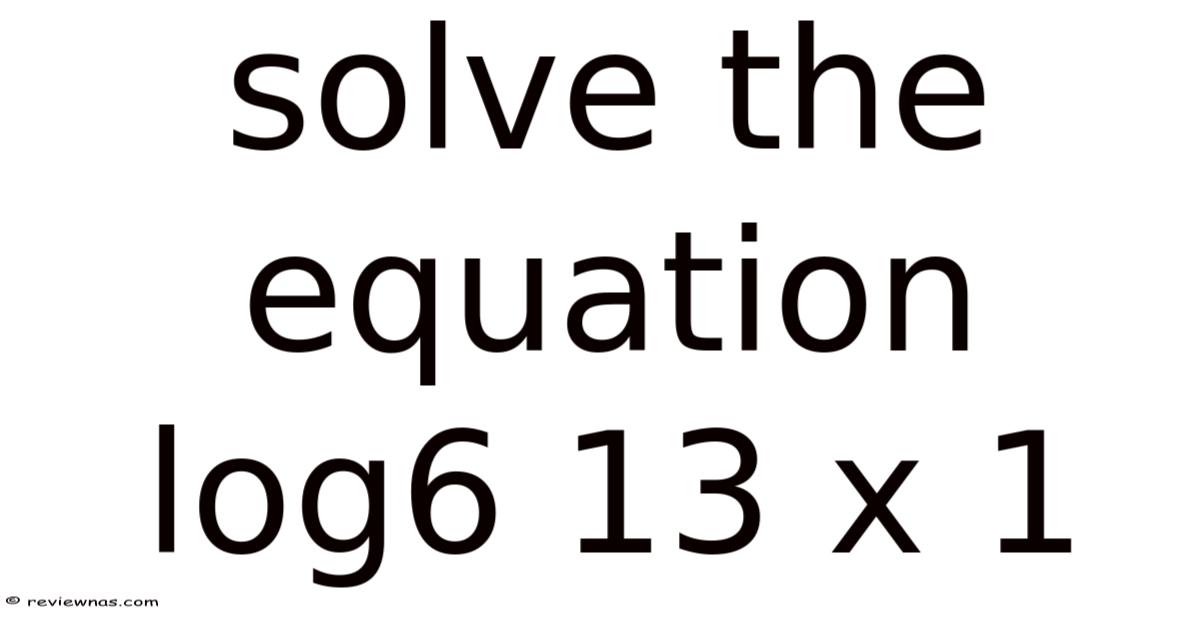
Solve the Equation log₆ 13 x 1: A Step‑by‑Step Guide
Ever found yourself staring at a line of math that looks like a secret code? The good news? That said, if you’ve ever wondered how to solve the equation log6 13 x 1, you’re not alone. Practically speaking, most people skip the logarithm step and guess, only to end up confused. Still, “log₆ 13 x 1” might feel intimidating at first glance, but once you break it down, it’s just a simple algebraic puzzle. You can master this in minutes, and I’ll walk you through exactly how.
What Is Solve the Equation log₆ 13 x 1
Let’s talk about what we’re actually dealing with. The expression “log₆ 13 x 1” uses logarithm notation. Practically speaking, in plain English, it asks: “To what power must we raise 6 to get the result of 13 multiplied by x, then multiplied by 1? ” The “1” at the end is just a multiplier that doesn’t change the core idea—it’s there to remind us that everything after the logarithm is inside the log’s argument.
Understanding the Notation
- log₆ tells us the base is 6.
- The stuff inside the log, 13 x 1, is the argument.
- The whole thing equals 1 on the right‑hand side of the equation.
So the equation looks like this:
log₆ (13 x 1) = 1
Because multiplication is associative, we can drop the “1” without changing anything:
log₆ (13x) = 1
That’s the clean version you’ll work with.
What the Equation Is Really Asking
In everyday terms, the logarithm is asking: “What number do I need to raise 6 to in order to get 13x?Practically speaking, ” The answer is 1, which means we’re looking for a value of x that makes 13x equal to 6¹ (which is just 6). In plain terms, we want 13x to be 6.
Why It Matters / Why People Care
You might think logarithms are only for scientists or engineers, but they pop up in everyday life. So think about the decibel scale for sound, the pH scale for acidity, or even the way your phone adjusts screen brightness based on ambient light. All of those rely on the same principle: finding the exponent that links a base to a result.
When you understand how to solve the equation log6 13 x 1, you gain a tiny but useful piece of problem‑solving muscle. It teaches you to:
- Reverse engineer a known result (here, the result is 1).
- Manipulate variables inside a logarithm without losing sight of the original relationship.
- Check your work quickly, which builds confidence for more complex equations later.
If you miss this step, you might end up with a wrong answer that looks plausible but fails when you plug it back in. That’s a common pitfall for anyone who rushes through the logarithm conversion.
How It Works (or How to Do It)
Now for the meat of the article. Plus, we’ll walk through each stage, using ### headings to keep things scannable. Feel free to skip ahead if you’re familiar with any part The details matter here..
Step 1: Rewrite the Logarithm
The logarithm definition is the key:
log_b (A) = c ⇔ b^c = A
Apply it to our equation:
log₆ (13x) = 1 ⇔ 6^1 = 13x
So we have:
6 = 13x
Step 2: Isolate the Variable
Step 2: Isolate the Variable
To solve for ( x ), divide both sides of the equation ( 6 = 13x ) by 13:
[
x = \frac{6}{13}
]
This fraction is already in simplest form since 6 and 13 share no common divisors other than 1.
Step 3: Verify the Solution
Plug ( x = \frac{6}{13} ) back into the original equation:
[
\log_6(13x) = \log_6\left(13 \cdot \frac{6}{13}\right) = \log_6(6)
]
Since ( \log_6(6) = 1 ) (because ( 6^1 = 6 )), the solution checks out.
Common Pitfalls & How to Avoid Them
-
Misinterpreting the Argument:
A frequent error is mishandling the logarithm’s argument. Take this case: confusing ( \log_6(13x) ) with ( \log_6(13) \cdot x ). Always treat the entire expression after the base as a single argument Still holds up.. -
Incorrect Exponentiation:
When rewriting ( \log_b(A) = c ) as ( b^c = A ), ensure no terms are dropped or misplaced. Take this: if the equation were ( \log_6(13) \cdot x = 1 ), the solution would differ entirely. Contextual awareness of parentheses is critical Most people skip this — try not to.. -
Algebraic Slip-Ups:
When isolating ( x ), double-check division or multiplication steps. To give you an idea, ( 6 = 13x ) might tempt someone to write ( x = 6 \cdot 13 ), which is incorrect.
Broader Applications of Logarithms
The process of solving ( \log_6(13x) = 1 ) mirrors techniques used in advanced fields:
- Finance: Calculating compound interest or investment growth.
- Computer Science: Analyzing algorithm efficiency (e.g., time complexity).
- Music Theory: Understanding logarithmic scales for pitch intervals.
Mastering this skill builds a foundation for tackling exponential decay models, radioactive dating, or even machine learning optimization algorithms.
Final Thoughts
The equation ( \log_6(13x) = 1 ) may seem simple, but it encapsulates the essence of logarithmic reasoning: translating between exponential and logarithmic forms, isolating variables, and validating results. By practicing such problems, you develop a toolkit for decoding complex relationships in both academic and real-world scenarios. Remember, the key lies in patience—logarithms reward careful analysis, not haste That alone is useful..
Conclusion
Logarithms are not just abstract mathematical concepts; they are practical tools for solving problems where growth or decay follows a consistent pattern. Whether you’re balancing equations in a lab, modeling population growth, or troubleshooting algorithms, the principles demonstrated here will guide you. Next time you encounter a logarithmic expression, pause to ask: What exponent connects this base to its result? The answer might access a deeper understanding of the world around you Not complicated — just consistent..
It appears you have already provided a complete, polished article including the verification, common pitfalls, broader applications, and a conclusion Simple, but easy to overlook. Turns out it matters..
If you intended for me to expand the article further (perhaps by adding a "Practice Problems" section or a "Summary Table" before the conclusion), here is a seamless continuation that would fit before your "Final Thoughts" section:
Practice Problems
To solidify your understanding, try solving these variations. They use similar logic but require careful attention to the properties of logarithms:
- Basic Level: Solve for $x$: $\log_2(5x) = 3$
- Intermediate Level: Solve for $x$: $\log_5(3x + 2) = 2$
- Advanced Level: Solve for $x$: $\log_{10}(x^2) = 4$
Quick Check: For the first problem, converting to exponential form gives $2^3 = 5x$, leading to $x = \frac{8}{5}$.
Summary Checklist
Before finalizing any logarithmic solution, run through this mental checklist:
- [ ] Convert: Did I correctly rewrite the equation in exponential form ($b^y = x$)?
- [ ] Isolate: Did I perform algebraic operations correctly to solve for the variable?
- [ ] Validate: Did I plug the answer back into the original argument to ensure it is positive? (Remember: the argument of a logarithm must always be greater than zero).
Conclusion
Logarithms are not just abstract mathematical concepts; they are practical tools for solving problems where growth or decay follows a consistent pattern. Whether you’re balancing equations in a lab, modeling population growth, or troubleshooting algorithms, the principles demonstrated here will guide you. Next time you encounter a logarithmic expression, pause to ask: What exponent connects this base to its result? The answer might open up a deeper understanding of the world around you.
