You've seen it a hundred times. Maybe in a calculus problem where the algebra trips you up. Also, maybe on a homework assignment. Maybe you're helping your kid with math and they stare at you like you've grown a second head Still holds up..
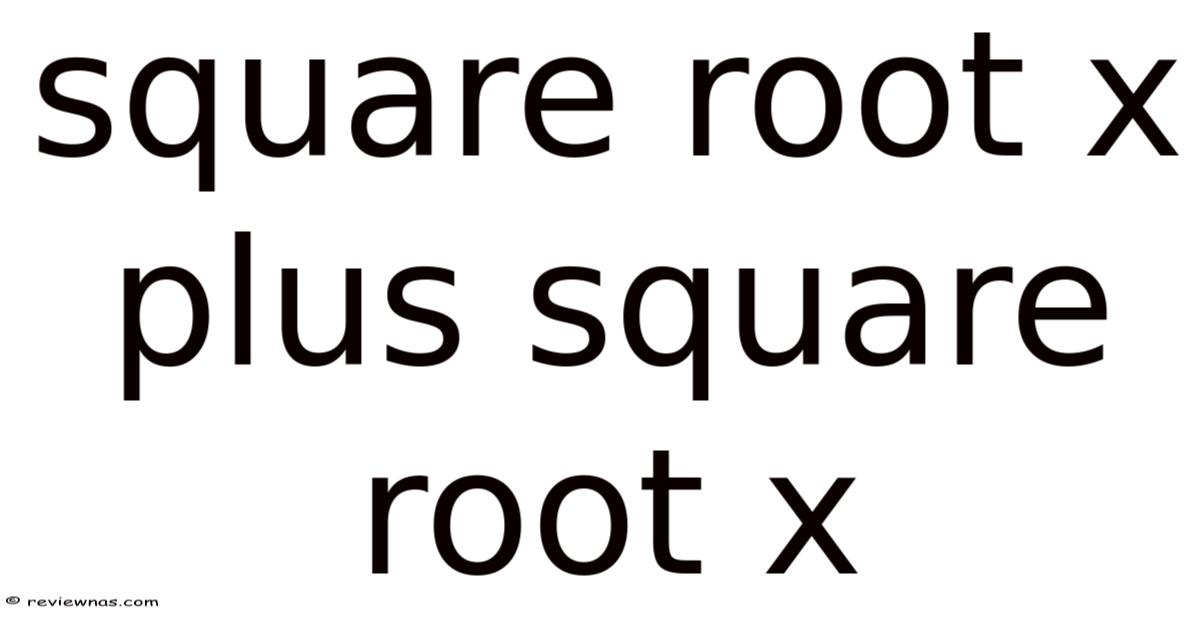
√x + √x
It looks like it should be complicated. In real terms, a variable. On the flip side, two radicals. That said, addition. Your brain wants to make it harder than it is.
Here's the thing: it's not That's the part that actually makes a difference..
What Is √x + √x
Two identical square roots added together. That's it. That's the whole expression Practical, not theoretical..
√x means "the number that, when multiplied by itself, gives you x." So √x + √x means you have that number twice The details matter here..
Think of it like apples. You don't have "apple squared" or "apple root two.If you have one apple and you get another apple, you have two apples. " You have 2 apples Worth knowing..
Same deal here. √x + √x = 2√x.
The coefficient appears out of nowhere
People freeze because there's no visible coefficient in front of the first radical. But there is one. Practically speaking, it's 1. Always.
1√x + 1√x = 2√x
The radical part — √x — acts like a variable term. Because of that, or 3y + 3y = 6y. In real terms, just like x + x = 2x. The radical doesn't change the rules of combining like terms Most people skip this — try not to..
It's not √(2x)
This is the mistake that haunts math teachers' dreams. Students see addition inside their head and think the radicands add.
√x + √x ≠ √(2x)
Let's test it with a number. Say x = 9 That's the part that actually makes a difference..
√9 + √9 = 3 + 3 = 6
√(2×9) = √18 ≈ 4.24
Not the same. Not even close.
The radical sign is not a parentheses. It doesn't distribute over addition. √(a + b) ≠ √a + √b. Ever. Burn that into your brain.
Why It Matters
You're thinking: okay, great, simple algebra. Why does this deserve an article?
Because this exact pattern shows up everywhere. And when it shows up in a larger problem, missing it costs you points — or worse, sends you down a rabbit hole of wrong answers.
Calculus derivatives
You're taking the derivative of something like √x + √x. If you don't simplify first, you differentiate term by term:
d/dx[√x] + d/dx[√x] = 1/(2√x) + 1/(2√x) = 2/(2√x) = 1/√x
But if you simplify first: 2√x. Derivative: 2 × 1/(2√x) = 1/√x Not complicated — just consistent..
Same answer. So naturally, second way is faster. Less room for arithmetic errors.
Integration
∫(√x + √x) dx
Simplify first: ∫2√x dx = 2∫x^(1/2) dx = 2 × (2/3)x^(3/2) = (4/3)x^(3/2) + C
Don't simplify: ∫√x dx + ∫√x dx = (2/3)x^(3/2) + (2/3)x^(3/2) = (4/3)x^(3/2) + C
Again — same result. But the first path is cleaner. In a timed exam, clean matters.
Solving equations
√x + √x = 6
2√x = 6
√x = 3
x = 9
Done. If you don't combine them first, you might square both sides prematurely and create a mess.
(√x + √x)² = 36
x + 2√x√x + x = 36
2x + 2x = 36
4x = 36
x = 9
It works — but you did extra work. And extra work is where sign errors live.
How It Works — Step by Step
Let's break it down like you're explaining it to someone who's never seen it before And that's really what it comes down to..
Step 1: Identify the terms
You have two terms: √x and √x.
A "term" is anything separated by + or −. Here, the plus sign splits the expression into two pieces.
Step 2: Check if they're like terms
Like terms have the exact same variable part. Same base, same exponent, same radical.
√x and √x? Still, identical. Same radicand (x), same index (2, implied).
√x and √y? Not like terms. Can't combine Nothing fancy..
√x and ∛x? Not like terms. Different index And that's really what it comes down to..
√x and x? Not like terms. One's a radical, one's not.
Step 3: Add the coefficients
Invisible coefficients are 1 Simple, but easy to overlook..
1√x + 1√x = (1 + 1)√x = 2√x
That's it. You're done Worth keeping that in mind..
Step 4: Check for further simplification
Can 2√x be simplified further? Only if x has a perfect square factor.
If x = 18: 2√18 = 2√(9×2) = 2×3√2 = 6√2
If x = 50: 2√50 = 2√(25×2) = 2×5√2 = 10√2
If x = 7: 2√7. Done. Nothing factors out.
Variations you'll actually see
It's not always written as √x + √x. Sometimes it's disguised.
3√x + 5√x = 8√x (coefficients 3 and 5)
√x + 2√x = 3√x (coefficients 1 and 2)
−√x + 4√x = 3√x (coefficients −1 and 4)
√x − √x = 0 (they cancel)
2√x + 3√x − √x = 4√x (2 + 3 − 1 = 4)
√(4x) + √x — wait, this one's different.
√(4x) = √4 × √x = 2√x. So 2√x + √x = 3√x The details matter here..
You have to simplify radicals before you check if they're like terms. Always Worth keeping that in mind..
Common Mistakes — What Most People Get Wrong
I've graded hundreds of papers. These errors show up every single time.
Mistake 1: Adding radicands
√x + √x = √(2x) ❌
We covered this. But it's so common it bears repeating. The radical is a grouping symbol — it only covers what's inside. It doesn't reach across the plus sign.
Mistake 2: Multiplying radicands
√x +
√x = √(x²) = x ❌
That's multiplication, not addition. √x × √x = x. But √x + √x = 2√x. Different operations, different rules.
Mistake 3: Forgetting invisible coefficients
√x + √x = √x ❌
They see one radical, they write one radical. Think about it: they forget each term carries a coefficient of 1. 1 + 1 = 2. Always.
Mistake 4: Combining unlike radicals
√x + √y = 2√(xy) ❌
√x + √x² = 2√x ❌ (√x² = |x|, not √x)
√8 + √2 = √10 ❌ (√8 = 2√2, so 2√2 + √2 = 3√2)
Simplify first. Then combine. Never the reverse.
Mistake 5: Dropping the radical entirely
2√x + 3√x = 5x ❌
The radical doesn't vanish. 2√x + 3√x = 5√x. It's not a variable you solve for — it's part of the term. The √x stays But it adds up..
Why This Matters Beyond the Classroom
You're not learning this to pass a quiz. You're learning it because algebraic fluency compounds.
When you see √x + √x in a physics problem — say, combining error terms in a pendulum period calculation — you don't want to pause and think. Also, the engineer adding tolerances. Same with the economist simplifying a utility function. You want 2√x to be automatic. The programmer optimizing a distance calculation.
Every extra step is a chance to err. Every hesitation burns working memory you need for the actual problem.
Mathematics isn't about following rules. In practice, it's about recognizing structure. Also, √x + √x has the same structure as 3x + 5x, or 2sinθ + 4sinθ, or 7eᵗ + 2eᵗ. The symbols change. The pattern doesn't It's one of those things that adds up..
Learn the pattern once. Apply it everywhere.
Quick Reference Card
| Expression | Simplified | Why |
|---|---|---|
| √x + √x | 2√x | 1 + 1 = 2 |
| 5√x + 3√x | 8√x | 5 + 3 = 8 |
| √x − √x | 0 | 1 − 1 = 0 |
| √x + √y | √x + √y | Unlike terms — stop |
| √18 + √8 | 5√2 | Simplify first: 3√2 + 2√2 |
| √x + x | √x + x | Unlike terms — stop |
Final Thought
Next time you see √x + √x, don't just solve it. Think about it: notice it. That moment of recognition — ah, like terms — is what separates students who calculate from students who understand.
The radical doesn't change the arithmetic. It just dresses it up.
You know how to add 1 + 1. You've known since kindergarten.
At its core, the same thing. Just wearing a square root costume.
