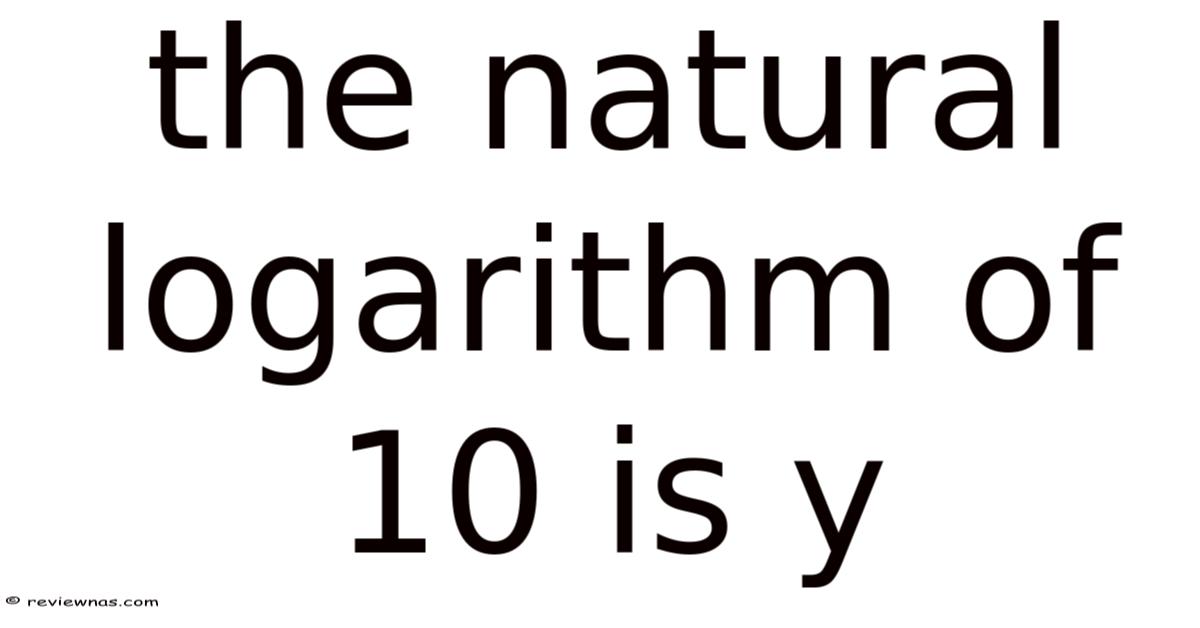
The natural logarithm of 10 is y. Think about it: that one‑line equation feels almost magical because it hides a deep relationship between the number 10 and the base‑e logarithm. In practice, y isn’t just a number—it’s a bridge that lets us convert multiplicative processes into additive ones, which is why anyone working with growth rates, compound interest, or even the pH scale runs into it sooner or later.
Here’s the thing: most people see “ln(10)” and glaze over because it looks like a random symbol pair. But the truth is, it’s a cornerstone of math that pops up in everything from finance to physics. By the time you finish reading, you’ll not only know what y actually is, you’ll see why it matters, how to compute it, and what most folks get wrong when they try to work with it Took long enough..
What Is the Natural Logarithm of 10?
At its core, the natural logarithm of 10 is the exponent you need to raise the mathematical constant e (≈ 2.71828) to in order to get 10. In symbols, that’s:
ln(10) = y ⇔ e^y = 10
Think of it as asking, “How many times do I need to multiply e by itself to reach 10?” The answer—y—is roughly 2.302585093. That number isn’t arbitrary; it’s the exact point where the exponential function e^x crosses the horizontal line at 10.
Why It’s Called “Natural”
The word “natural” isn’t just a fancy label. The constant e shows up whenever a quantity changes at a rate proportional to its size—think of bacterial growth, radioactive decay, or continuously compounded interest. Because of that, the natural logarithm is the go‑to tool for turning those exponential relationships into linear ones. Basically, it’s the mathematical translator for growth.
How It Differs From Common Logarithms
You’ve probably heard of log base 10 (written simply as log(10) in many contexts). The natural logarithm, however, uses e as its base, which makes it the preferred choice when the underlying process is continuous rather than discrete. That said, that one answers, “What power of 10 gives 10? Still, in practice, this distinction matters because using the wrong base can throw off calculations by a factor of about 2. ” The answer is 1. 3 (the very value of y itself).
Why It Matters
Real‑World Impact
The moment you hear about “doubling time” in epidemiology, finance, or even social media growth, the natural logarithm of 10 often sneaks in. In practice, 10years—about **23. To give you an idea, if an investment grows at a continuous rate of 10 % per year, the time it takes to increase tenfold isln(10) / 0.03 years**. That’s why investors and analysts keep y close at hand; it’s the hidden factor that turns a percentage into a tangible timeline Small thing, real impact..
Why People Care
People who work with data love the natural logarithm because it smooths out exponential curves. Take a dataset where sales rise by 10 % each month. Plotting raw numbers gives a steep curve that’s hard to read. That's why applying ln to each month’s sales flattens the line, making trends easier to spot and forecast. In short, y lets analysts see the underlying linear story hidden inside exponential noise Not complicated — just consistent..
How It Works
Calculating ln(10) Step by Step
-
Start with the definition
e^y = 10 -
Take the natural logarithm of both sides
ln(e^y) = ln(10) -
Use the property ln(e^y) = y
y = ln(10) -
Plug into a calculator or series expansion
Modern calculators give you y ≈ 2.302585093. If you don’t have a calculator, you can approximate it using the Taylor series for ln(1 + x) or known values.
Approximation Tricks
- Log‑table method: Historically, scientists used log tables that listed ln(1.1) ≈ 0.
1.0953, one could estimate ln(10)by breaking 10 into a product of numbers with known logs. 1) ≈ 0.1) to interpolate values. Here's a good example: knowingln(1.On the flip side, this method is cumbersome—modern tools like calculators or software libraries compute ln(10) with precision in milliseconds Most people skip this — try not to. That alone is useful..
Quick note before moving on.
The Bigger Picture
The natural logarithm’s ubiquity stems from its deep ties to calculus. The derivative of ln(x) is 1/x, a property that simplifies integration and differentiation of exponential functions. This makes ln indispensable in physics (e.g., solving differential equations for motion), engineering (signal processing), and even machine learning (optimizing algorithms via gradient descent). Its connection to Euler’s identity e^(iπ) + 1 = 0 further cements its role in unifying algebra, geometry, and complex analysis.
Conclusion
The natural logarithm of 10 isn’t just a number—it’s a bridge between abstract mathematics and tangible reality. From calculating compound interest to modeling population dynamics, ln(10) quantifies the time it takes for exponential processes to scale by an order of magnitude. While its approximate value of 2.3026 might seem mundane, it embodies the elegance of how growth, decay, and change manifest across disciplines. In a world driven by data, understanding ln(10) isn’t about memorizing digits; it’s about grasping the rhythm of the universe itself—where every 10-fold leap is but a whisper of e's enduring influence And it works..
From Theory to Everyday Tools
When a programmer writes a routine to normalize scores, they often rely on the identity
[ \log_{e}(x)=\frac{\ln x}{\ln e} ]
to convert between logarithmic bases. Now, because (\ln e = 1), the conversion is trivial, yet it illustrates how the natural log serves as a universal reference point. In statistical software, functions such as log() default to the natural base, meaning that a single call can simultaneously compute growth rates, confidence intervals, and hazard ratios. This design choice stems from the fact that derivatives of exponential models simplify dramatically when expressed in terms of (e), reducing computational overhead and numerical error.
Short version: it depends. Long version — keep reading.
Numerical Techniques for High‑Precision Values
For applications that demand more than the standard double‑precision approximation, several algorithms are employed:
- Continued‑fraction expansions: By expressing (\ln(10)) as a nested fraction, one can achieve arbitrary accuracy with only a handful of iterations.
- Binary splitting: This method recursively halves the problem, turning the series for (\ln(1+x)) into a fast‑converging sum that converges in logarithmic time relative to the desired number of digits.
- Padé approximants: Rational functions that approximate (\ln(1+x)) far beyond the radius of convergence of its Taylor series, allowing accurate evaluations even for large arguments after suitable scaling.
These techniques are baked into libraries such as Boost, GNU MPFR, and the C++ <cmath> header, ensuring that engineers can retrieve (\ln(10)) to thousands of decimal places in a fraction of a second.
Biological and Physical Analogues
In population dynamics, the logistic growth model can be linearized by taking the natural logarithm of the ratio of carrying capacity to remaining capacity. The resulting expression reveals a constant “intrinsic rate” that is independent of the initial population size—a property that mirrors the steadiness of (\ln(10)) across disparate scales. Day to day, similarly, in thermodynamics, entropy change for an isothermal process is given by ( \Delta S = nR\ln\frac{V_f}{V_i} ). When the volume expands tenfold, the entropy increase is precisely (nR\ln(10)), underscoring how the natural logarithm translates multiplicative changes into additive measures that are easier to aggregate And it works..
Synthesis
The natural logarithm of ten stands at the intersection of pure mathematics, computational practice, and real‑world phenomena. Its approximate value of 2.302585… is more than a convenient constant; it is a conduit through which exponential growth, decay, and scaling are rendered comprehensible. By converting multiplicative relationships into additive ones, (\ln(10)) empowers analysts, engineers, and scientists to distill complex dynamics into linear frameworks that can be visualized, optimized, and predicted with confidence.
Conclusion
Understanding (\ln(10)) is tantamount to grasping the pulse of any system that evolves by factors rather than fixed increments. Consider this: whether one is calibrating a financial model, simulating a chemical reaction, or decoding the entropy of a black hole, the same modest constant governs the rhythm of change. In recognizing this shared foundation, we appreciate how a single mathematical notion can echo across disciplines, turning the abstract elegance of (e) into the tangible language of everyday growth.
People argue about this. Here's where I land on it.
