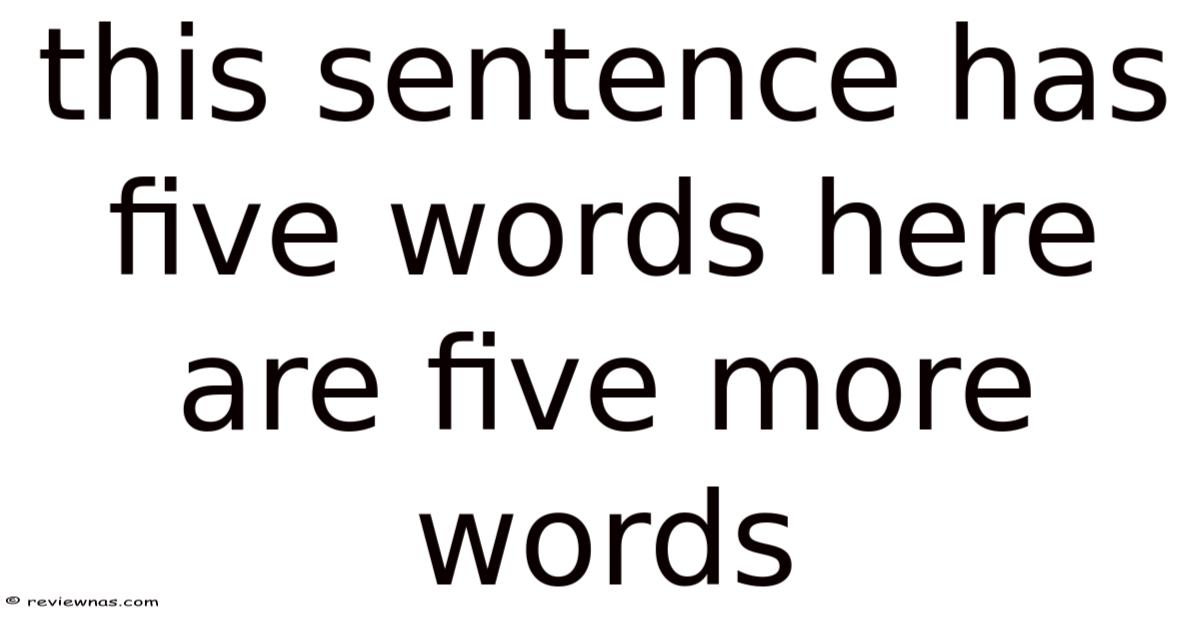
Ever count the words in a sentence just because someone dared you to? Consider this: this sentence has five words here are five more words. And somehow, that little game says more about how we read than most people realize.
I stumbled on this phrase a while back and couldn't stop thinking about it. It's stupidly simple. It's also weirdly addictive once you start noticing sentence length everywhere you look That alone is useful..
What Is "This Sentence Has Five Words Here Are Five More Words"
Look, it's not a product. It's not a theory you need a degree to understand. Day to day, the phrase is exactly what it says — a sentence made of five words, followed by another five words. That's the whole trick Simple, but easy to overlook. Took long enough..
But here's the thing — it's become a kind of inside joke among writers, editors, and people who care about how language lands. Also, you'll see it used as a demo of parallel structure. Or as a test of whether someone's actually reading. Or just as a silly status update when someone's bored.
Why The Count Matters
Five and five is balanced. Your brain feels that even if you don't name it. On top of that, a sentence of five words is short enough to land like a punch. Two of them back to back feel rhythmic, almost like a beat in a song.
Not Just A Gimmick
Turns out this kind of phrasing shows up in real writing all the time. Poets do it. Copywriters do it. That friend who texts in weird little chunks is basically doing it too. The format is a tiny window into how we shape meaning through length.
Why People Care About Something So Small
Why does this matter? Because of that, because most people skip how a sentence feels and only chase what it says. But the feel is half the message Not complicated — just consistent..
When you write "this sentence has five words here are five more words," you're doing something a 40-word paragraph can't. That's why you're making the reader slow down. You're making them count without asking them to. And in a feed full of noise, that tiny bit of participation is rare Simple, but easy to overlook..
I know it sounds simple — but it's easy to miss. We're trained to skim. Something this short forces a blink of attention. Even so, that's why teachers use it. That's why social posts using it get weirdly high saves Small thing, real impact. That alone is useful..
What Changes When You Notice It
Once you see the five-and-five pattern, you start seeing other patterns. You can't unsee it. Writers who open with a long sentence then gut-punch you with a short one. Speakers who repeat a phrase to make a point stick. And your own writing gets better because of it.
What Goes Wrong Without It
Without any sense of rhythm, writing drags. Worth adding: it becomes a wall. The reader's eye slides off. I've read blog posts — maybe you have too — where every sentence is the same length and you're asleep by paragraph three. The five-word trick is a reminder that length is a tool, not an accident.
Short version: it depends. Long version — keep reading The details matter here..
How It Works In Real Writing
The short version is: you use constraint to create attention. Here's how to actually do it, whether you're writing a caption or a chapter.
Step One: Pick Your Unit
Decide the word count you're playing with. You could do seven. You could do three. Still, the point is you commit. Five is common because it's tight but complete. "This sentence has five words here are five more words" only works because both halves obey the rule.
Step Two: Make The First Half Stand Alone
The first five words should make sense by themselves. They don't need the second half, but they set up a curiosity. "This sentence has five words" is a claim. It makes the reader want proof.
Step Three: Deliver The Payoff
The next five words confirm the claim. "Here are five more words.Because of that, " Done. Because of that, the reader counts, realizes you kept your promise, and feels a tiny hit of satisfaction. That's the whole loop Small thing, real impact..
Step Four: Use It Sparingly
Real talk — if every sentence in your article is five and five, you'll drive people nuts. It's a spice. That said, you drop it in to wake the room up. Then you go back to normal prose and the contrast does the work Simple, but easy to overlook..
Step Five: Watch The Rhythm In Everything
After you've played with this, start varying your sentences on purpose. On the flip side, medium one that trails off. Short one. And long one. The five-word pair is just the entry drug to actual rhythmic writing.
Common Mistakes People Make With This
Honestly, this is the part most guides get wrong. They treat the phrase like a magic spell. It isn't.
Mistake One: Thinking Length Is The Whole Game
Some new writers hear about this and think "I'll just write short sentences and win.Which means " No. In practice, a page of only five-word lines reads like a ransom note. The power comes from contrast with longer stuff around it.
Mistake Two: Forgetting Punctuation
"This sentence has five words here are five more words" with no period in the middle is still ten words technically. And the beat breaks if you don't separate them. Most people miss that the pause is what makes it work.
Mistake Three: Using It To Show Off
If you drop it in just to prove you know it, readers feel that. They always do. Use it because it fits the moment, not because you want a gold star.
Mistake Four: Ignoring Meaning
Five words of pure nonsense twice isn't clever, it's noise. That's why the original works because the first half states a fact and the second half proves it. Keep your paired sentences honest Small thing, real impact..
Practical Tips That Actually Work
Want to use this without looking like a gimmick account? Here's what I've found after years of dumb language experiments.
- Open a section with it. When you're three paragraphs into a heavy topic, hit them with "This sentence has five words here are five more words." It breaks the trance.
- Use it in captions. Social algorithms love saves. A tiny puzzle saves better than a quote card.
- Teach it to a kid. Nothing shows you understand a concept like explaining five-word pairs to a seven-year-old.
- Count out loud when editing. Read your draft and tap for each sentence length. If it's all the same, rewrite three of them.
- Don't explain the joke. If you use the phrase, let it sit. Adding "see what I did there" kills it.
The thing is, most writing advice is about big structures. Outlines. On top of that, hooks. Even so, sEO. All real. But the small stuff — a five-word mirror, a pause, a count — is what makes a reader stay. Worth knowing.
FAQ
Is "this sentence has five words here are five more words" a real grammar rule?
No. It's a constraint game, not a rule. Grammar doesn't require paired five-word sentences. It's a stylistic pattern writers use for rhythm and attention Simple as that..
Where did the five-word sentence pair come from?
Hard to say exactly. It spread as a writing exercise and a meme. The structure shows up in style guides as an example of parallelism and intentional brevity That's the part that actually makes a difference..
Can I use this in professional writing?
Yes, if it fits. A newsletter, a blog, a speech — all fair game. Just don't open a legal brief with it unless you're very sure of your audience.
Does sentence length really affect reading?
It does. Short sentences increase pace and tension. Long ones slow things down and add context. Mixing them keeps a reader awake. The five-and-five pattern is a shortcut to feeling that mix And it works..
How do I count the words correctly?
Every word counts: articles, prepositions, everything. "This sentence has five words" is five. "Here are five more words" is five. Put a period between them and you've got the beat Still holds up..
Next time you're staring at a blank page, try writing something stupidly small. This sentence has five words here are five more words. Then go back to the real work — but you'll write the real work a little sharper than before.
