Ever sat in a car, staring out the window at a passing highway sign, and suddenly felt that weird mental math itch? You know the one. You’re looking at the distance to the next city, checking your speedometer, and your brain starts trying to calculate exactly when you’ll arrive.
It’s a simple concept, really. But for some reason, the moment we try to turn that intuition into actual math, everything gets blurry. We mix up the numbers, we divide the wrong way, and suddenly we’re lost in a sea of variables No workaround needed..
Here’s the truth: most people struggle with this because they try to memorize a formula instead of understanding the relationship between the pieces. But once you get it? In real terms, you’ll see the world differently. You’ll start seeing the logic behind how everything moves.
What Is Time Equals Distance Divided by Rate
At its core, this isn't some complex physics theory. It’s just a way to describe how long it takes to get from Point A to Point B. If you understand how fast you're going and how far you have to go, you can figure out when you'll arrive.
Think of it like this. Worth adding: imagine you're walking down a long hallway. The length of that hallway is your distance. And the speed at which your feet are moving is your rate. The amount of time you spend walking is your time.
If you walk a long distance very slowly, it takes a long time. If you run that same distance, it takes much less time. That’s the fundamental relationship. The distance and the rate are the two things that dictate the time But it adds up..
The Three Pillars of Motion
To make this work, you have to keep three distinct variables in mind:
- Distance: This is the total ground covered. It could be miles, kilometers, meters, or even light-years if you're feeling ambitious.
- Rate: This is how much distance you cover in a single unit of time. Usually, we call this speed. It's miles per hour, meters per second, or knots.
- Time: This is the duration of the movement. It’s how long the journey lasts.
The Magic Triangle
If you’ve ever studied basic algebra, you’ve probably seen the "formula triangle." It’s a little trick used to keep these three things straight. You put Distance at the top of a triangle, and Rate and Time at the bottom The details matter here. Worth knowing..
If you want to find distance, you multiply rate by time. If you want to find time, you divide distance by rate. If you want to find rate, you divide distance by time. Because of that, it’s a closed loop. Once you understand that these three are locked together, you can solve for any one of them as long as you have the other two.
Why It Matters / Why People Care
You might be thinking, "Okay, I get it. I can calculate my arrival time. Why does this matter beyond a road trip?
Well, because everything in the universe is moving.
In a practical sense, this math is the backbone of logistics, aviation, and shipping. When a massive cargo ship is crossing the Atlantic, the crew isn't just guessing when they'll hit the port. They are using precise calculations of distance and rate to manage fuel, crew shifts, and docking schedules. If they get the math wrong, they run out of fuel in the middle of the ocean. That’s a very expensive mistake.
On a more personal level, understanding this relationship helps you manage your most precious resource: time.
If you know you have to be at a meeting in 45 minutes, and you know you're currently 20 miles away, you can calculate whether you need to drive 25 mph or 45 mph to get there on time. It turns "I hope I make it" into "I know I'll make it." It moves you from a state of guesswork to a state of control.
How It Works (or How to Do It)
Let's get into the weeds. To actually use this, you have to follow a specific logic. You can't just throw numbers at a page and hope they stick. You have to ensure your units are talking to each other Worth knowing..
Step 1: Identify Your Variables
Before you do any math, you have to look at the information you have. This is where most people trip up. They see a number and immediately try to divide it by something else without checking what that number actually represents.
Ask yourself:
- Do I know how far I'm going? Now, (Distance)
- Do I know how fast I'm moving? (Rate)
- Do I know how long it's taking?
If you have two of these, you can find the third. If you don't have two, you're stuck Most people skip this — try not to. Worth knowing..
Step 2: Check Your Units
This is the part that actually matters in the real world. This is where the math breaks And that's really what it comes down to..
If your distance is in miles, but your rate is in kilometers per hour, your answer will be complete nonsense. You can't divide miles by kilometers and expect a meaningful time. You have to convert everything into a single, consistent system before you even touch a calculator And that's really what it comes down to..
If you're working with hours and minutes, be careful. "1 hour and 30 minutes" is not "1.3 hours.Which means " It is 1. 5 hours. Think about it: this is a classic trap. Worth adding: always convert your time into a decimal format (like 1. 5 or 0.75) before you start dividing That alone is useful..
Step 3: The Calculation
Once your units are aligned, the math is actually quite simple.
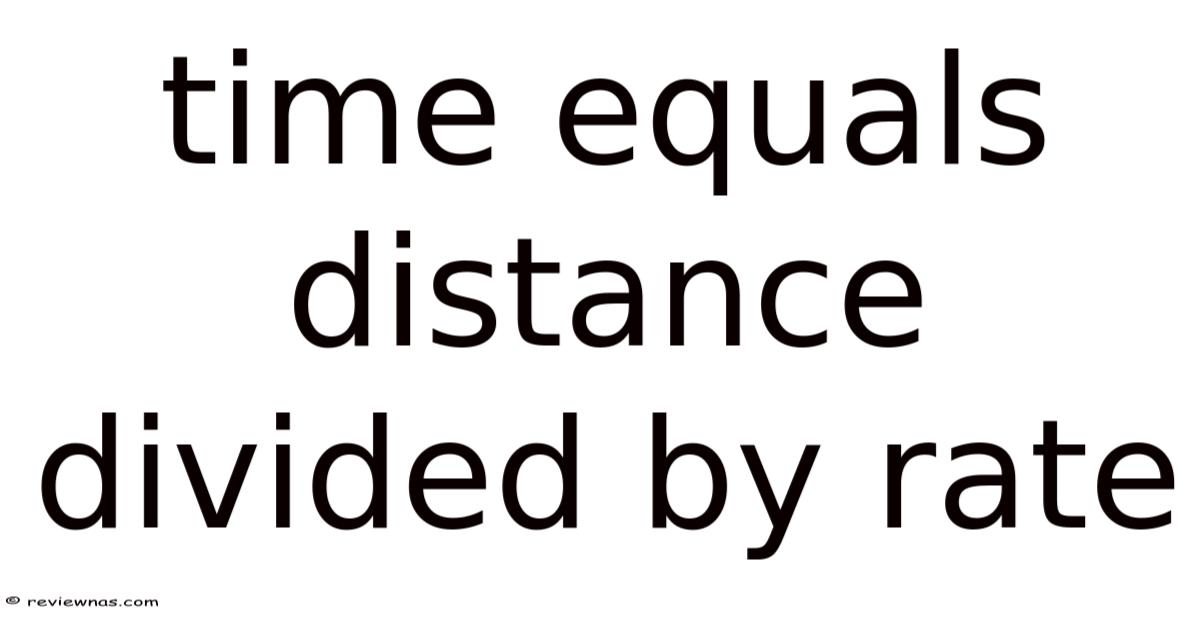
Time = Distance / Rate
Let's run a quick example. You're driving to a friend's house. The distance is 150 miles. You're driving at a steady rate of 50 miles per hour.
150 divided by 50 equals 3.
It will take you 3 hours. Easy, right?
What if you're running? So you're running a 5k (which is 5,000 meters). Your rate is 2 meters per second.
5,000 divided by 2 equals 2,500.
It will take you 2,500 seconds. Worth adding: to make that useful, you'd divide that by 60 to get roughly 41. 6 minutes.
The Inverse Relationship
Here is the part that is actually worth knowing: the relationship between rate and time is inversely proportional.
This is a fancy way of saying that as one goes up, the other goes down. Now, if you slow down your rate, your time increases. Practically speaking, they move in opposite directions. Also, if you increase your rate (speed), your time decreases. This is why speeding doesn't just get you there faster; it changes the entire math of your journey.
Common Mistakes / What Most People Get Wrong
I've seen people struggle with this for years, and it usually comes down to one of three things.
First, there's the Unit Mismatch. Plus, as I mentioned earlier, trying to mix miles and kilometers, or hours and minutes, is the fastest way to fail. It’s a simple error, but it happens to everyone—even engineers.
Second, people often confuse Rate with Time. Here's the thing — they get the direction of the math backwards. Worth adding: they see "50 miles in 2 hours" and they try to divide 50 by 2 to get the time. But 50 divided by 2 gives you the rate (25 mph). Always remember: if you want the time, you must divide the distance by the speed That's the part that actually makes a difference. And it works..
Third, there is the "Average vs. Because of that, instantaneous" problem. That's why this is a big one. Also, in a textbook, you go 60 mph for 100 miles. In real life, you go 70 mph for ten minutes, then you hit a red light and sit at 0 mph for three minutes, then you go 40 mph through a school zone Worth knowing..
People argue about this. Here's where I land on it.
When people try to calculate their arrival time using their current speedometer reading, they often fail because they aren't accounting for the average rate. To get an accurate time, you need to know
the total distance traveled and the total time elapsed, not just the number currently displayed on your dashboard.
Summary Checklist
To ensure you never fall into these mathematical traps again, keep this quick mental checklist handy:
- Check your units: Are everything in the same system (miles/miles, meters/meters)?
- Convert time to decimals: Have you turned those minutes into a fraction of an hour?
- Identify your goal: Are you looking for Distance (multiply), Rate (divide distance by time), or Time (divide distance by rate)?
- Use Average, not Instantaneous: Are you using your constant speed or your actual average speed for the whole trip?
Conclusion
Mastering the relationship between distance, rate, and time is about more than just passing a math test; it is about developing a practical intuition for the world around you. Whether you are planning a road trip, calculating your pace for a marathon, or managing a professional project deadline, understanding these mechanics allows you to make informed decisions rather than guesses.
Once you stop viewing these as abstract numbers and start seeing them as a balanced system of moving parts, the math becomes second nature. Remember: align your units, identify your variables, and always account for the reality of the journey. If you do that, you'll never find yourself lost—literally or mathematically.
