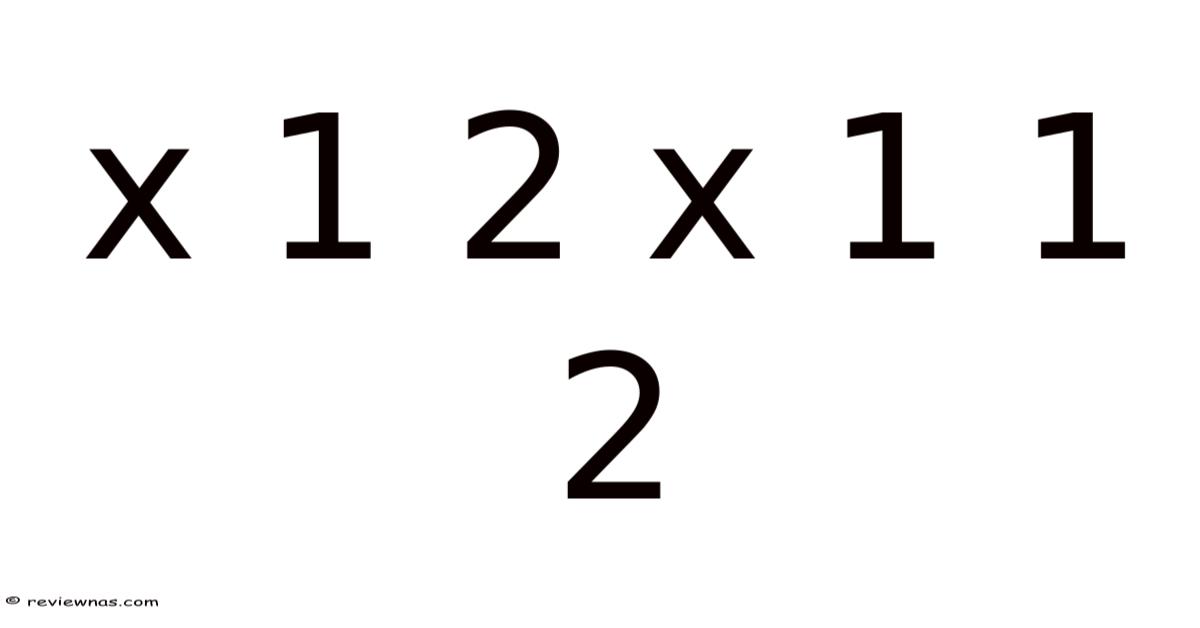
What Is x 1 2 x 1 1 2
You’ve probably stumbled across it in a forum thread, a cryptic tweet, or a tech blog footnote. At first glance it looks like a random string of characters, but there’s actually a pattern hiding in plain sight. In this post we’ll unpack x 1 2 x 1 1 2, explore why it matters, and give you a toolbox for working with it in real‑world projects. No jargon dumps, no robotic definitions—just a conversation with someone who’s spent enough time staring at this odd little sequence to know its quirks That's the part that actually makes a difference..
Why It Matters
You might wonder, “Why should I care about a random alphanumeric combo?” The answer is simpler than you think. Whenever you see x 1 2 x 1 1 2 pop up, it’s often a shorthand for a deeper concept—whether that’s a versioning scheme, a data tag, or a hidden rule in a piece of software. Miss it, and you could be debugging for hours; catch it, and you’ll spot the shortcut before anyone else does Simple, but easy to overlook..
In practice, recognizing x 1 2 x 1 1 2 can help you:
- Avoid version‑collision errors in collaborative codebases
- Decode legacy configuration files that use the same syntax
- Communicate more efficiently with teammates who already speak the language
That’s why a solid grasp of this pattern is more than a curiosity; it’s a practical skill that saves time and reduces frustration.
How It Works (or How to Decode It)
Below we’ll walk through the anatomy of x 1 2 x 1 1 2, breaking it down step by step. Each subsection uses an ### heading so you can skim or dive deep as you wish.
### The Building Blocks
At its core, x 1 2 x 1 1 2 is a sequence of tokens separated by spaces. Let’s label them:
- x – a placeholder that often denotes an unknown or variable component
- 1 – the first numeric marker, usually indicating a primary version or level
- 2 – the second numeric marker, frequently representing a sub‑level or secondary iteration
- x – repeats the placeholder, suggesting a return to the variable state
- 1 – a third numeric marker, often signifying a patch or minor update
- 1 – a fourth numeric marker, sometimes indicating a revision number
- 2 – the final numeric marker, commonly a build identifier
Understanding each token helps you map the whole string onto a logical hierarchy And that's really what it comes down to..
### Contextual Uses
The same pattern can appear in different contexts, and the meaning shifts accordingly. Here are three common scenarios:
- Software versioning – developers might label a release as x 1 2 x 1 1 2 to signal “variable major, minor 2, patch 1, revision 1, build 2.”
- Configuration files – a settings file could reference x 1 2 x 1 1 2 as a key that toggles a feature flag.
- Data serialization – in some APIs, the sequence encodes a unique identifier for a record, where each number maps to a field.
Spotting the context clues—like surrounding brackets, colons, or comments—lets you interpret the right meaning on the fly.
### Mapping to a Logical Hierarchy
If you picture the sequence as a tree, the first x is the root node. Worth adding: the numbers that follow are child nodes branching out. So the second x re‑enters the root, indicating a loop back to the starting point, while the final numbers refine the leaf nodes. Visualizing it this way can make complex version strings feel far more manageable.
Common Mistakes
The shortcut’s adaptability amplifies its value in collaborative environments, where precision and alignment are key. By recognizing such patterns early, teams can align their efforts more effectively, reducing friction and accelerating consensus. This approach not only streamlines communication but also fosters a shared understanding of project goals, ensuring everyone contributes harmoniously. And such efficiency gains ripple through workflows, enhancing productivity while maintaining quality standards. Still, ultimately, mastering these nuances empowers teams to deal with complexity with confidence, reinforcing their collective ability to deliver results cohesively. A cornerstone of modern collaboration, it bridges individual insights into unified outcomes, solidifying its role as a vital asset in dynamic settings.
Easier said than done, but still worth knowing.
Common Mistakes
Misinterpreting or mishandling the x 1 2 x 1 1 2 pattern can lead to errors that ripple through development cycles. Here are frequent pitfalls to avoid:
- Treating “x” as a literal value – The placeholder “x” often signifies variability or absence, not a fixed number. Assuming it represents a specific value (e.g., “1”) can distort version logic or configuration settings.
- Ignoring context cues – Without considering surrounding syntax (e.g., brackets, colons), teams might misread the sequence as a flat list rather than a hierarchical identifier, leading to misaligned updates or misconfigurations.
- Overlooking the loop-back “x” – The second “x” in the sequence can be mistaken for a typo, but it often indicates a reset or return to a base state, critical in iterative processes.
- Inconsistent documentation – Failing to standardize how these tokens are defined across teams or projects creates ambiguity, especially when merging codebases or integrating systems.
- Assuming universal meaning – The same pattern may encode different data in distinct systems (e.g., software versions vs. database keys). Blindly applying interpretations across contexts risks unintended consequences.
Conclusion
The x 1 2 x 1 1 2 pattern, while deceptively simple, serves as a versatile tool for encoding structured information across technical domains. Contextual awareness ensures accurate interpretation, while avoiding common mistakes safeguards against errors in versioning, configuration, and data handling. Practically speaking, by breaking down each component—recognizing fixed markers, variable placeholders, and their hierarchical relationships—professionals can decode and apply these sequences with precision. Mastering this pattern not only streamlines workflow efficiency but also strengthens collaborative alignment, making it an indispensable skill in modern technical environments.
Looking Ahead
As the pace of digital transformation accelerates, the x 1 2 x 1 1 2 motif will increasingly surface in emerging paradigms such as low‑code orchestration platforms, decentralized identity frameworks, and AI‑driven configuration generators. Teams that embed a habit of dissecting these tokens during the design phase will find it easier to adapt when new symbols replace the legacy “x” placeholder, ensuring continuity without sacrificing productivity.
Practical Guidance for Teams
- Create a shared reference sheet that maps each token to its intended purpose, complete with examples drawn from the specific stack in use.
- Automate validation checks in CI pipelines to flag mismatched interpretations before code reaches production.
- Encourage cross‑disciplinary reviews, inviting both engineers and domain experts to verify that the pattern’s semantics align with business requirements.
- Document edge cases where the same sequence might carry divergent meanings, and maintain a living glossary to capture those nuances.
The Bigger Picture
Beyond the immediate technical gains, a disciplined approach to patterns like x 1 2 x 1 1 2 cultivates a culture of precision and mutual trust. When every stakeholder can confidently read and modify these embedded identifiers, the organization becomes more resilient to change, able to pivot quickly in response to market demands, and better positioned to innovate without the baggage of legacy ambiguities Nothing fancy..
Conclusion
In sum, the seemingly modest sequence x 1 2 x 1 1 2 serves as a microcosm of the broader challenges and opportunities that define contemporary technical work. By systematically unpacking its components, contextualizing its usage, and instituting safeguards against common missteps, teams reach a reliable pathway to clearer communication, smoother integration, and higher‑quality outcomes. Embracing this disciplined mindset today equips organizations to work through the increasingly detailed landscapes of tomorrow with confidence and cohesion Not complicated — just consistent..
Real talk — this step gets skipped all the time Worth keeping that in mind..
