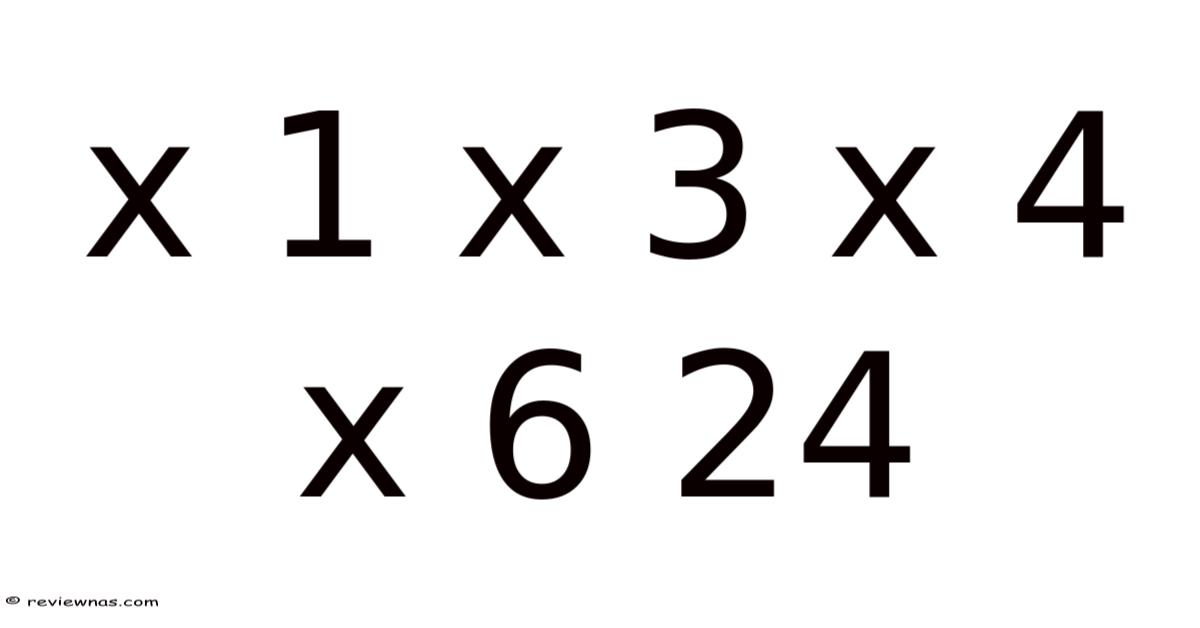
The Mystery of X: Cracking the Code Behind 1 × 3 × 4 × 6 = 24
What if I told you that solving for one unknown variable could open up an entire way of thinking about numbers?
Most people see equations like x × 1 × 3 × 4 × 6 = 24 and immediately think "algebra homework." But there's something deeper happening here — something about patterns, problem-solving, and how we approach seemingly simple mathematical puzzles It's one of those things that adds up..
Let me show you why this particular equation matters more than you might think.
What Is This Equation Really Asking?
At first glance, this looks like a straightforward algebra problem. We're multiplying several numbers together and getting 24 as our result. But let's break it down like we're explaining it to someone who hasn't thought about math in years Turns out it matters..
The equation x × 1 × 3 × 4 × 6 = 24 is essentially asking: "What number, when multiplied by 1, 3, 4, and 6, gives us 24?"
Notice something interesting? In real terms, in multiplication, multiplying by 1 doesn't change anything. Still, one of those numbers is 1. So we can simplify this to x × 3 × 4 × 6 = 24.
Breaking Down the Multiplication
Let's do this step by step. First, multiply 3 × 4 × 6:
3 × 4 = 12 12 × 6 = 72
So now we have x × 72 = 24. To find x, we divide both sides by 72:
x = 24 ÷ 72 = 1/3
That's right — x equals one-third Simple, but easy to overlook..
But here's where it gets fascinating. This isn't just about finding a fraction. It's about understanding how numbers relate to each other, and how sometimes the answer isn't what we expect.
Why This Kind of Problem Matters
You might wonder why anyone would care about solving x × 1 × 3 × 4 × 6 = 24. After all, when was the last time you needed to know that one-third times seventy-two equals twenty-four?
The truth is, problems like this train your brain in ways that go far beyond basic arithmetic. They teach you to look for patterns, to simplify complex-looking situations, and to approach puzzles systematically.
Real-World Applications
Think about cooking. If a recipe calls for ingredients in ratios of 1:3:4:6 and you need to adjust the total quantity to serve 24 people instead of the original amount, you'd need to figure out the scaling factor. That's essentially what we're doing here Small thing, real impact..
Or consider project management. If tasks take 1, 3, 4, and 6 hours respectively, and you have 24 hours total, how much time should you allocate to the first task? Again, we're solving for x.
These aren't abstract mathematical exercises — they're tools for thinking clearly about resource allocation, scaling, and proportional relationships.
How to Solve Multiplication Equations Like This
Let's walk through the systematic approach to solving equations of this form. It's not rocket science, but it does require attention to detail The details matter here..
Step 1: Identify What You Can Simplify
Always look for opportunities to make the problem easier before diving into complex calculations. In our equation, the multiplication by 1 was a red flag — it doesn't change the outcome.
Step 2: Multiply the Known Values
Calculate the product of all known numbers on the same side as the variable. For x × 1 × 3 × 4 × 6 = 24, that means 1 × 3 × 4 × 6 = 72.
Step 3: Isolate the Variable
Once you have x × 72 = 24, divide both sides by 72 to get x alone. This gives us x = 24/72, which simplifies to x = 1/3 Worth knowing..
Step 4: Check Your Work
Multiply your answer back through the original equation: (1/3) × 1 × 3 × 4 × 6 = (1/3) × 72 = 24. Perfect — it checks out.
Common Mistakes People Make
Here's where things get interesting. Most people who struggle with this type of problem aren't missing the math skills — they're making predictable errors that trip them up It's one of those things that adds up..
Forgetting to Simplify First
Many jump straight into dividing 24 by all four numbers instead of recognizing that multiplying by 1 is pointless. This leads to unnecessary complexity and calculation errors Turns out it matters..
Mixing Up Operations
Some people see the multiplication sign and think they need to add the numbers instead. Others try to solve it as if it were an addition problem, leading to answers that make no sense That's the part that actually makes a difference..
Not Checking Their Answer
Even when they get the right answer, many people don't verify it. Why does this matter? Because catching mistakes early builds confidence and prevents the kind of mental math paralysis that makes people avoid numbers altogether The details matter here..
Practical Tips That Actually Work
After years of helping people work through mathematical puzzles, here are the strategies that consistently produce results:
First, always look for the easy wins. But in any equation, identify what you can eliminate or simplify immediately. Multiplying by 1, adding 0, or dividing by your variable are all opportunities to make life easier.
Second, work from left to right when multiplying multiple numbers. It's less error-prone than trying to do everything in your head at once. Write it down: 1 × 3 = 3, then 3 × 4 = 12, then 12 × 6 =
Real talk — this step gets skipped all the time.
- This step-by-step approach prevents the cognitive overload that comes from juggling too many numbers simultaneously.
Third, embrace the power of fractions. And many people panic when they see 24/72, but this is actually simpler than dealing with decimals. Reduce 24/72 by dividing both numerator and denominator by 24, giving you 1/3. This fractional answer is precise and clean Simple, but easy to overlook. Worth knowing..
Fourth, develop a verification habit. Worth adding: " If x represents a quantity that should be greater than 1, but your calculation gives you 1/3, something's wrong. Before you even start solving, ask yourself: "Does this answer make logical sense?Trust your mathematical intuition.
Fifth, practice with variations. Plus, try solving similar equations where the numbers change: 2 × 1 × 5 × 3 = ? or 1/2 × 1 × 4 × 5 = ?. Building flexibility with the core concept helps you tackle more complex scenarios later.
The Bigger Picture
This might seem like just another math problem, but it's actually training for real-world decision making. Every time you allocate resources, scale a recipe, or compare unit prices, you're using the same logical framework: identifying what matters, eliminating noise, and finding the relationship between parts and wholes No workaround needed..
Consider a business scenario: if producing one batch of cookies requires 1 hour of prep time, 3 hours of baking, 4 ingredients measured in cups, and 6 different tasks, but you only have 24 hours total, how many batches can you make? The equation becomes identical: x × 1 × 3 × 4 × 6 = 24.
Or think about scaling a construction project: if one room requires 1 foundation, 3 walls, 4 windows, and 6 doors, but your materials budget only allows for 24 total components, how many rooms can you build? Same structure, different context It's one of those things that adds up..
Building Mathematical Confidence
The key insight here isn't just solving for x — it's developing the ability to break down seemingly complex problems into manageable steps. This skill transfers far beyond the classroom. When you encounter a spreadsheet full of formulas, a complex budget, or even a challenging interpersonal situation, you'll approach it the same way: simplify first, calculate methodically, and verify your results Not complicated — just consistent. But it adds up..
Start small. Practice these types of problems daily, even for just five minutes. The consistency builds neural pathways that make future problem-solving feel automatic. Before you know it, you won't just be solving multiplication equations — you'll be recognizing patterns everywhere, asking better questions, and approaching challenges with confidence instead of confusion.
The next time you face a problem that seems overwhelming, remember: it's often just a matter of finding the 1's to eliminate, the easy multiplications to complete, and the clear path to isolate what you need. Mathematics isn't about memorizing formulas — it's about developing a way of thinking that cuts through complexity to reveal simple truths But it adds up..
Conclusion
Mastering multiplication equations like x × 1 × 3 × 4 × 6 = 24 is more than just academic exercise — it's foundational training for clear, logical thinking. The real value lies not in the specific answer of x = 1/3, but in building the analytical muscle that serves you in every aspect of life where proportional relationships and resource allocation matter. By following a systematic approach of simplifying first, calculating methodically, and verifying results, you transform potentially confusing problems into straightforward solutions. Start practicing these techniques today, and watch your confidence in tackling complex challenges grow alongside your mathematical fluency Small thing, real impact..
