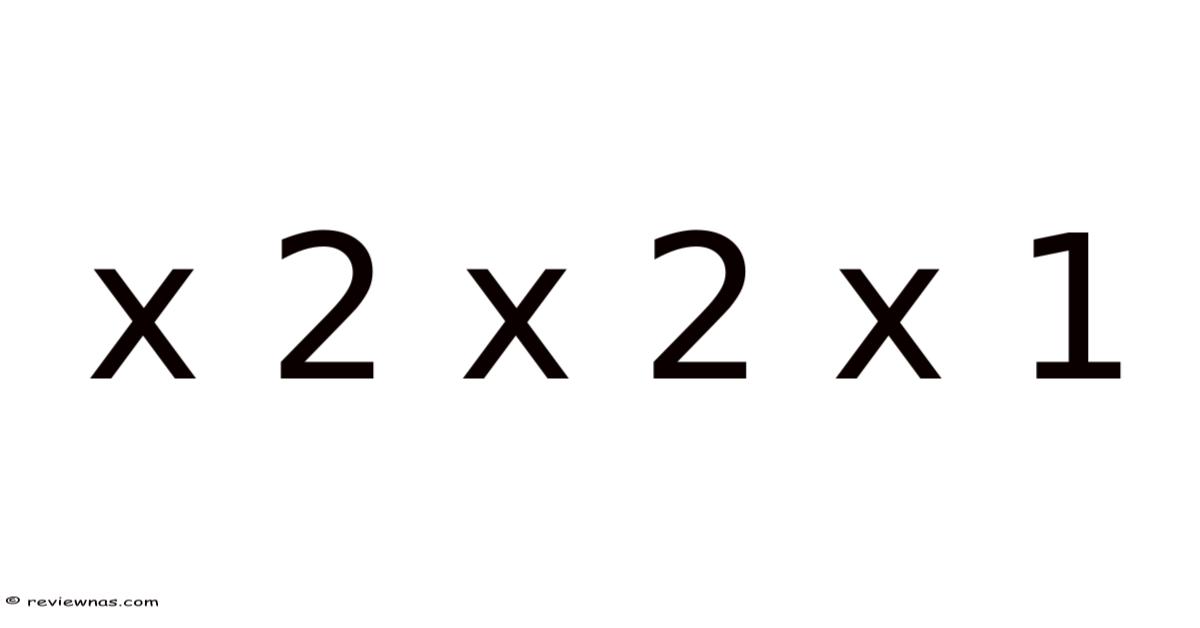
What Is x 2 x 2 x 1?
Let’s cut right to it — you’re looking at a simple multiplication expression: x 2 x 2 x 1. At first glance, it looks straightforward. But there’s something subtle here that trips people up more often than you’d think.
This isn’t about solving for x just yet. That's why it’s about understanding what this expression represents and how to work with it confidently. In practice, the expression x 2 x 2 x 1 means we’re multiplying x by 2, then by another 2, then by 1. So written out: x × 2 × 2 × 1 That's the part that actually makes a difference. No workaround needed..
Short version: it depends. Long version — keep reading.
And here’s the thing — order matters in multiplication, but not in the way most people assume. Day to day, unlike addition, where you can shuffle numbers around all day, multiplication has rules. But they’re not complicated But it adds up..
Breaking Down the Expression
So what do we have? One variable (x) multiplied by three constants: 2, 2, and 1.
Let’s walk through it step by step:
- Start with x.
- Multiply by 2 → 2x
- Multiply by 2 again → 2x × 2 = 4x
- Multiply by 1 → 4x × 1 = 4x
That’s it. The simplified form of x 2 x 2 x 1 is just 4x.
It seems almost too easy, right? But here’s where confusion creeps in — people mix up the order, forget that multiplying by 1 changes nothing, or lose track of what’s a variable and what’s a number.
Why It Matters
You might be thinking, “So what? It’s just 4x. Now, big deal. ” But bear with me — this little expression is a gateway to bigger ideas.
Understanding how to simplify expressions like x 2 x 2 x 1 is foundational. It’s the difference between guessing and knowing. Between fumbling through algebra and moving through it with confidence Still holds up..
Real-World Applications
Let’s say you’re calculating the total cost of buying x items, and each item costs $2, with a bulk discount that doubles your effective price to $4, then you’re looking at 4x. Or maybe you’re scaling a recipe — doubling ingredients twice and then realizing you’re quadrupling them.
These aren’t hypotheticals. They’re the kinds of mental math shortcuts we use every day without realizing it.
And in algebra, getting this right means you can tackle word problems, equations, and functions with much more ease. You stop second-guessing yourself and start trusting your process That's the part that actually makes a difference..
How It Works (or How to Do It)
Alright, let’s get practical. Here’s how to handle x 2 x 2 x 1 — or any similar expression — like a pro.
Step 1: Identify What You’re Working With
You’ve got one variable (x) and three numbers (2, 2, 1). That’s your landscape. No exponents, no parentheses, just straight multiplication.
Step 2: Multiply the Constants First
This is where most shortcuts live. Instead of carrying x around, multiply the numbers: 2 × 2 × 1 Simple, but easy to overlook..
- 2 × 2 = 4
- 4 × 1 = 4
So now you’re left with 4x. Clean. Simple. Done Turns out it matters..
Step 3: Don’t Overthink It
Here’s the thing — multiplication is commutative. Even so, that means you can multiply in any order. 2 × 1 × 2 gives you the same result as 2 × 2 × 1. So if you’re ever stuck, rearrange and simplify Which is the point..
But again — don’t overcomplicate. The goal is to make the expression as clean as possible.
Step 4: Check Your Work
Plug in a number for x and see if both sides match That alone is useful..
Let’s try x = 3:
Original: 3 × 2 × 2 × 1 = 12
Simplified: 4 × 3 = 12
Same answer. Good.
Try x = 0:
Original: 0 × 2 × 2 × 1 = 0
Simplified: 4 × 0 = 0
Still good. That’s your sanity check Still holds up..
Common Mistakes / What Most People Get Wrong
Okay, let’s talk about where things go sideways. That said, because honestly? Most mistakes with x 2 x 2 x 1 aren’t about complexity — they’re about carelessness Simple, but easy to overlook..
Mistake #1: Forgetting That Multiplying by 1 Changes Nothing
This one’s everywhere. People see x 2 x 2 x 1 and think, “Oh, I need to do something with the 1.Plus, ” But multiplying by 1 is like adding zero — it does nothing. So 4x × 1 is still 4x.
Quick note before moving on.
Mistake #2: Mixing Up Order of Operations
Some folks try to “solve” x first before multiplying. But x is a variable — you can’t solve it without more info. The whole point is to simplify the expression, not evaluate it.
Mistake #3: Treating It Like an Equation
If you see x 2 x 2 x 1 and think, “Where’s the equals sign?” you’re not alone. But this is an expression, not an equation. There’s no solution unless you’re setting it equal to something.
Mistake #4: Overcomplicating with Distributive Property
Here’s a sneaky one. Some people try to distribute x across the multiplication. Like: x(2)(2)(1). But that’s not how it works. You’re not distributing — you’re simplifying.
Practical Tips / What Actually Works
Let’s leave the theory behind for a second and talk about what helps in real life.
Tip #1: Always Multiply the Numbers First
Before you bring the x back into it, knock out the constants. 2 × 2 × 1 = 4. Then slap an x on front. Boom — 4x.
Tip #2: Use Substitution to Verify
Pick a number. Plug it in. Day to day, it’s slow, but it works. See if both versions match. And if you’re learning, it builds confidence.
Tip #3: Practice with Variations
Try these:
- x 3 x 2 x 1 → 6x
- x 5 x 1 x 2 → 10x
- x 4 x 1 x 1 → 4x
See the pattern? Multiply the numbers, keep the x, done Most people skip this — try not to..
Tip #4: Write It Out (Seriously)
Don’t do it in your head if you’re not sure. On the flip side, then cross out the x and replace with 4x. Write: x × 2 × 2 × 1. Visuals help.
Tip #5: Don’t Rush
I know, I know — it’s just a few numbers. But rushing leads to errors. Slow down. Because of that, do it right. Your future self will thank you.
FAQ
Q: Is x 2 x 2 x 1 the same as 4x?
Yes. Absolutely. Multiply the constants: 2 × 2 × 1 = 4. Attach the x. Done.
Q: Can I solve for x if there’s no equals sign?
Not really. Without an equation, you can only simplify. You need something like x 2 x 2 x 1 = 8 to solve for x And that's really what it comes down to..
Q: Does the order of multiplication matter?
Nope. Thanks to the commutative property, you can multiply in any order. 2 × 1 × 2 is still 4.
Q: What if x is negative?
It doesn’t change the simplification. x 2 x 2 x 1 still becomes 4x, even if x is negative. Try x = -2: -2 × 2 × 2 × 1 = -8, and 4 × -2 = -8. Works.
Q: Is this the same in algebra 2 or higher math?
Yep. The rules don’t change. You might get more variables or exponents later, but the core idea of simplifying stays the same.
Final Thoughts
So there you have it — x 2 x 2 x 1 simplifies to
So there you have it — x 2 x 2 x 1 simplifies to 4x. Practically speaking, this example underscores a fundamental truth in mathematics: clarity comes from understanding structure, not just performing calculations. By avoiding the traps of premature solving, equation confusion, or overcomplicating steps, you align with the core principles of algebraic simplification. These tips aren’t just shortcuts—they’re tools to build precision and confidence in problem-solving. On top of that, whether you’re a student grappling with basics or a professional refining your skills, mastering expressions like this one is a reminder that math rewards patience and methodical thinking. But keep practicing, stay curious, and remember: even the simplest expressions can trip you up if you rush. With time, you’ll internalize these patterns, turning what seems daunting into second nature.
