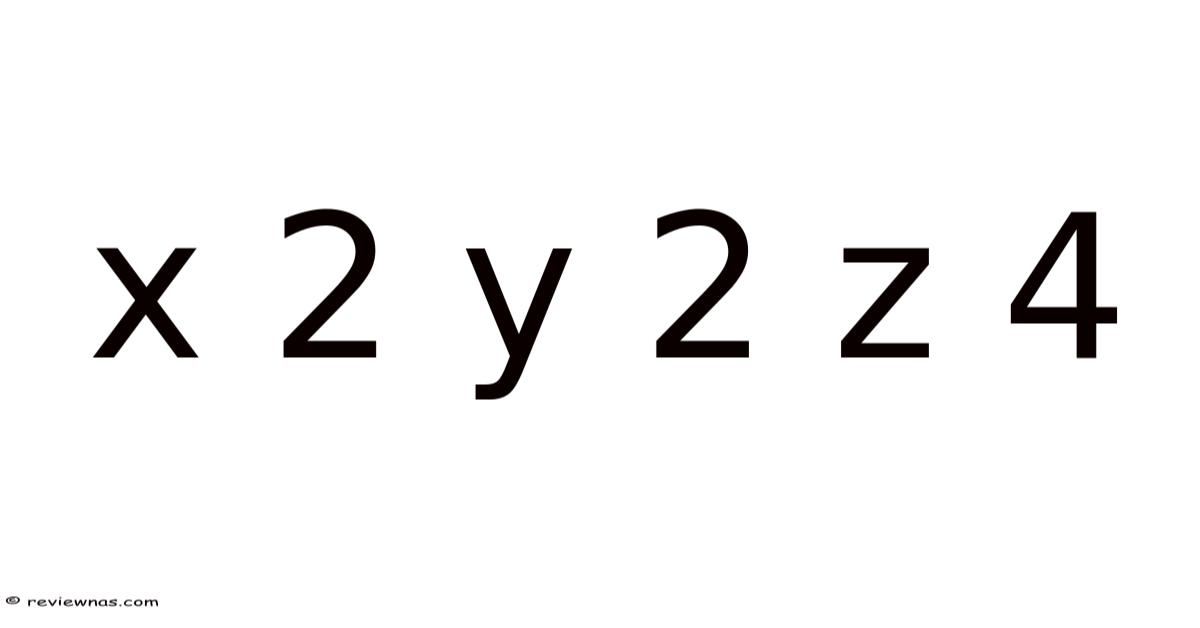
What does x 2 y 2 z 4 actually mean?
You’ve probably seen something like this tucked into a homework problem or a formula sheet and wondered why the numbers are floating next to the letters. Think about it: it looks like a secret code, but it’s really just a compact way of showing how many times each variable is multiplied by itself. In plain language, x 2 y 2 z 4 is shorthand for x squared times y squared times z to the fourth power. If you prefer the usual math notation, it’s written as (x^2 y^2 z^4) Less friction, more output..
Think of it like a recipe: you need two scoops of x, two scoops of y, and four scoops of z, all mixed together. The “scoops” aren’t additive; they’re multiplicative, which is why the exponents matter.
Why should you care about x 2 y 2 z 4?
At first glance, an expression like this might seem like just another abstract piece of algebra. But the moment you start working with formulas in physics, engineering, or even finance, you’ll run into terms that look exactly like this. Understanding how to read, manipulate, and simplify them saves you from making silly errors that can blow up a whole calculation Simple as that..
As an example, the kinetic energy of a rotating rigid body involves terms like (I \omega^2), where the moment of inertia I itself might contain factors of (x^2 y^2 z^4) depending on the geometry. If you misinterpret the exponent on z as a simple multiplier, you’ll end up with an answer that’s off by a factor of z² — and in real‑world applications, that could mean the difference between a bridge that stands and one that doesn’t.
Beyond the technical side, getting comfortable with expressions like x 2 y 2 z 4 builds a deeper intuition for how variables interact. It trains you to see patterns, factor common pieces, and spot when something can be simplified before you even start crunching numbers And that's really what it comes down to..
How it works: breaking down the pieces
The role of exponents
An exponent tells you how many times to multiply the base by itself. So:
- (x^2) means (x \times x)
- (y^2) means (y \times y)
- (z^4) means (z \times z \times z \times z)
When you see them written side by side with no operator in between, the default operation is multiplication. Therefore (x^2 y^2 z^4) is exactly ((x \times x) \times (y \times y) \times (z \times z \times z \times z)).
Multiplying like terms
If you ever need to combine this expression with another that shares the same bases, you add the exponents. For instance:
[ (x^2 y^2 z^4) \times (x^3 y z^2) = x^{2+3} y^{2+1} z^{4+2} = x^5 y^3 z^6 ]
Notice how the coefficients (if there were any) would multiply normally, while the exponents on identical bases are added. This rule is the backbone of simplifying polynomial expressions.
Dividing expressions
Division works similarly, but you subtract exponents:
[ \frac{x^2 y^2 z^4}{x y^3} = x^{2-1} y^{2-3} z^{4-0} = x^1 y^{-1} z^4 = \frac{x z^4}{y} ]
A negative exponent just means the base belongs in the denominator. Keeping track of signs here prevents a lot of head‑scratching later And it works..
Raising a power to another power
If the whole monomial is itself raised to an exponent, you multiply each inner exponent by the outer one:
[ (x^2 y^2 z^4)^3 = x^{2\cdot3} y^{2\cdot3} z^{4\cdot3} = x^6 y^6 z^{12} ]
This comes up frequently when you’re dealing with formulas that involve scaling, like converting units or adjusting a model for size.
Common mistakes people make with x 2 y 2 z 4
Treating exponents as coefficients
Among the most frequent slip‑ups is reading (x^2) as “2 times x” instead of “x times x”. And that mistake turns a quadratic term into a linear one and throws off every subsequent step. If you catch yourself thinking “2x”, pause and rewrite the term as (x \cdot x) to remind yourself what the exponent really does Practical, not theoretical..
Forgetting the implicit multiplication
Because there’s no symbol between the factors, some learners assume they need to add or do something else. Remember: juxtaposition means multiplication. If you ever see a space or line break between the parts, it’s still multiplication unless a plus, minus, or division sign is explicitly written.
Mishandling negative or fractional exponents
When the expression shows up in a denominator or under a radical, the exponents can become negative or fractional. Which means it’s easy to lose track and either drop the sign or misplace the term. A safe habit is to rewrite the expression with all factors in the numerator first, apply the exponent rules, then move any negative powers back down The details matter here..
Over‑simplifying incorrectly
Sometimes people try to combine unlike bases, like saying (x^2 y^2 = (xy)^2). That’s actually true, but only because the exponents are identical. If the exponents differed — say (x^2 y^3) — you can’t merge them into a single base with a single exponent. Always check that the powers match before you attempt to factor them together Most people skip this — try not to..
Practical tips for working with x 2 y 2 z 4
Write it out in expanded form when you’re unsure
If a step feels fuzzy, temporarily expand each power:
[ x^2 y^2 z^4 = (x \cdot x) \cdot (y \cdot y) \cdot (z \cdot z \cdot z \cdot z) ]
Seeing the raw multiplication makes it obvious where each factor belongs and helps you avoid accidental addition or subtraction of exponents.
Use parentheses to group complex terms
When the expression is part of a larger formula, wrap it in parentheses before applying
Using parentheses to group complex terms
When the expression appears inside a larger algebraic statement — say, as part of a product with another factor or inside a fraction — wrap the whole (x^2 y^2 z^4) segment in parentheses before you apply any additional operations Simple as that..
Take this: consider
[ \frac{(x^2 y^2 z^4)^2}{(x y z)^3} ]
First, expand the numerator using the power‑to‑a‑power rule:
[ (x^2 y^2 z^4)^2 = x^{2\cdot2} y^{2\cdot2} z^{4\cdot2}=x^4 y^4 z^8 ]
Now the denominator is ((x y z)^3 = x^{3} y^{3} z^{3}).
Dividing the two results gives
[ \frac{x^4 y^4 z^8}{x^3 y^3 z^3}=x^{4-3} y^{4-3} z^{8-3}=x^{1} y^{1} z^{5}=x y z^{5} ]
Notice how the parentheses helped us keep track of the entire base before raising it to a power and before performing the division And that's really what it comes down to..
Substituting concrete numbers for verification
If you ever doubt whether the exponent rules have been applied correctly, plug in simple numbers for (x), (y) and (z) and evaluate both the original and the simplified forms.
Take (x=2,; y=3,; z=1):
- Original: (x^2 y^2 z^4 = 2^2\cdot3^2\cdot1^4 = 4\cdot9\cdot1 = 36)
- Simplified after raising to the 2nd power and dividing by ((xyz)^3): (x y z^{5}=2\cdot3\cdot1^{5}=6)
Now compute the whole fraction step‑by‑step with those numbers:
[ \frac{(2^2\cdot3^2\cdot1^4)^2}{(2\cdot3\cdot1)^3} = \frac{36^2}{6^3} = \frac{1296}{216}=6 ]
The numeric check confirms that the algebraic manipulation was correct Worth knowing..
A quick reference checklist
- Identify each base – locate every variable or coefficient that is being raised to a power.
- Apply the power‑to‑a‑power rule – multiply exponents when a power contains another power.
- Combine like bases only when exponents match – otherwise keep them separate.
- Watch the direction of exponents – moving a factor from numerator to denominator flips the sign of its exponent.
- Verify with substitution – plug in simple values to ensure the simplified expression matches the original.
Real‑world illustration
Suppose you are scaling a three‑dimensional model where the length of each edge is proportional to (x), (y) and (z) respectively, and the volume is given by (V = x^2 y^2 z^4). Still, if you double each linear dimension (i. e That's the whole idea..
[ (2x)^2 (2y)^2 (2z)^4 = 2^{2+2+4},x^2 y^2 z^4 = 2^{8},x^2 y^2 z^4 = 256,x^2 y^2 z^4 ]
Thus the volume scales by a factor of (2^8 = 256). Understanding how each exponent contributes to the overall scaling factor is a direct application of the rules we’ve just reviewed.
Conclusion
The expression (x^2 y^2 z^4) may look deceptively simple, but mastering its manipulation unlocks a host of algebraic techniques — from expanding and simplifying polynomials to handling scaling transformations in geometry and physics. Think about it: by consistently applying the exponent laws, respecting implicit multiplication, and using parentheses and substitution as safety nets, you can avoid the most common pitfalls and work with confidence. Whether you’re simplifying a fraction, raising a power to another power, or modeling real‑world phenomena, the strategies outlined here provide a reliable roadmap for handling any algebraic expression that involves powers of (x), (y) and (z).
