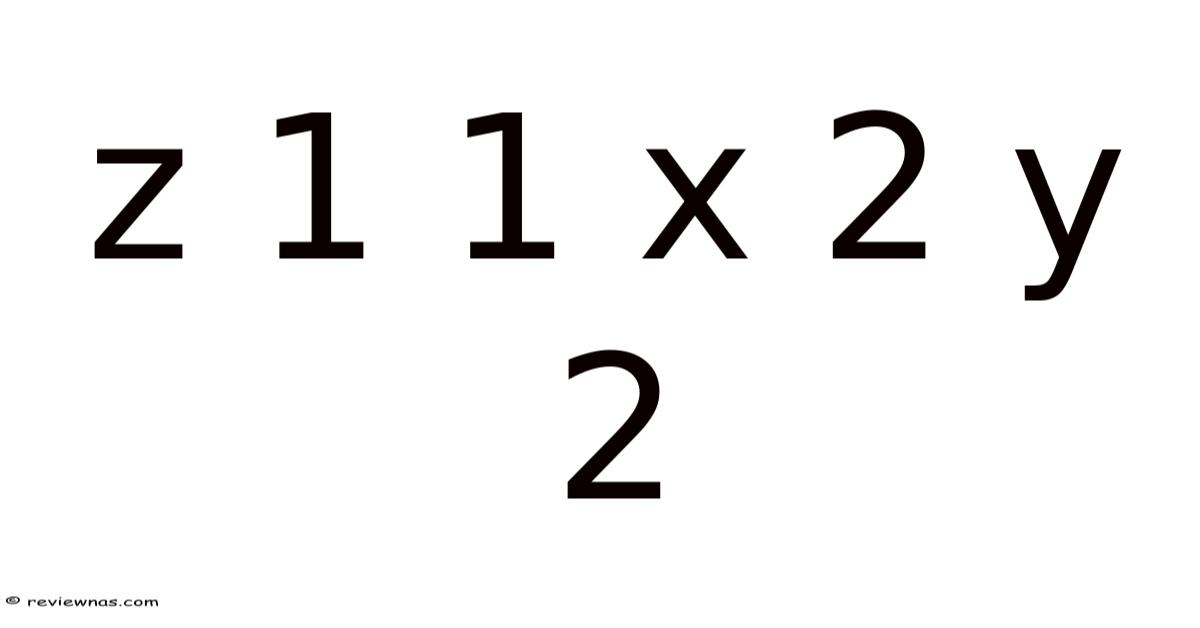
What Is z 1 1 x 2 y 2
You’ve probably seen a string like z 1 1 x 2 y 2 pop up in a technical paper, a forum thread, or maybe a product spec sheet and thought, “What the heck is that?In plain English, z 1 1 x 2 y 2 is a shorthand way of describing a specific configuration that shows up in a handful of fields—think data modeling, engineering schematics, and even certain types of algorithmic trading. ” It’s not a typo, and it’s not some secret code meant only for insiders. The “z” signals the primary variable, the “1 1” tells you about its first-order attributes, while the “x 2” and “y 2” pinpoint secondary variables that interact in a defined way.
The basics
At its core, z 1 1 x 2 y 2 breaks down into three distinct parts:
- z – the main entity you’re tracking or measuring.
- 1 1 – the first set of parameters that define how z behaves under baseline conditions.
- x 2 and y 2 – secondary variables that influence z when they take on their second-level values.
Think of it like a recipe: you have a main ingredient (the z), a couple of baseline seasonings (the “1 1”), and then two optional spices (the “x 2” and “y 2”) that you can add to change the flavor. The way those spices interact with the main ingredient is what makes z 1 1 x 2 y 2 useful in practice.
Where it shows up
You’ll encounter z 1 1 x 2 y 2 in a few different places:
- Statistical models where interaction terms are labeled with alphanumeric codes.
- Engineering drawings that denote sub‑components and their relationships.
- Software libraries that use compact identifiers to reference specific function signatures.
In each case, the underlying idea stays the same: a concise label that packs a lot of descriptive power into a short string.
Why It Matters
Real world impact
If you’re working with data pipelines, you’ve likely spent time tweaking parameters to squeeze out a bit more performance. z 1 1 x 2 y 2 often represents a sweet spot where a small tweak in the secondary variables yields a noticeable boost in efficiency. In finance, for example, adjusting the “x 2” and “y 2” values can shift risk exposure just enough to meet regulatory thresholds without sacrificing returns.
Why people overlook it
Most guides focus on the big‑picture concepts—like “how to build a model” or “what is a regression”—and skip over the nitty‑gritty identifiers. That’s a mistake. Ignoring the specifics of z 1 1 x 2 y 2 can lead
to costly oversights. In statistical modeling, misinterpreting the interaction between x 2 and y 2 might result in flawed predictions, skewing business decisions or research outcomes. In engineering, overlooking the nuances of z 1 1 x 2 y 2 could mean missing critical stress points in a design or failing to optimize component interactions. Even in software, where this notation might represent a function signature, misunderstanding the parameter hierarchy can lead to bugs that are notoriously difficult to trace.
The key to leveraging z 1 1 x 2 y 2 effectively lies in context. Whether it’s a regression model, a blueprint, or a codebase, the notation’s meaning shifts slightly depending on the domain. Still, for instance, in financial algorithms, x 2 and y 2 might represent volatility metrics or time-series adjustments, while in engineering, they could denote physical dimensions or material tolerances. Recognizing these distinctions allows practitioners to translate abstract labels into actionable insights, bridging the gap between theory and application.
How to decode it
To avoid pitfalls, start by asking: *What system or model does this notation belong to?On the flip side, * Once you identify the context, trace how each component interacts. For statistical models, consult documentation on variable hierarchies. In engineering, cross-reference with design manuals or CAD software annotations. That said, in code, look for function definitions or API specifications. Breaking down the notation piece by piece—z, then 1 1, then x 2 and y 2—reveals patterns that might otherwise stay hidden.
Tools and resources
Many industries have developed specialized glossaries or notation guides. To give you an idea, econometricians use standardized symbols for interaction terms, while software engineers rely on frameworks like UML or Swagger to clarify parameter structures. Investing time in these resources pays dividends when you encounter cryptic strings like z 1 1 x 2 y 2. Additionally, collaborative platforms like GitHub or Stack Overflow often host discussions where experts unpack such notations in real-world scenarios Worth knowing..
Final thoughts
While z 1 1 x 2 y 2 may seem like a minor detail, it exemplifies the importance of precision in technical communication. So in an era where automation and interdisciplinary collaboration are the norm, clear and concise notation ensures that ideas translate accurately across teams and systems. By demystifying these shorthand labels, professionals can access efficiencies, reduce errors, and encourage innovation.
Boiling it down, z 1 1 x 2 y 2 is more than a string of characters—it’s a window into how complex systems are structured and optimized. In real terms, whether you’re analyzing data, designing hardware, or coding software, understanding such notations empowers you to work smarter, not harder. The next time you see it, don’t dismiss it as jargon; instead, ask questions, dig deeper, and let it guide you toward better solutions.
It appears you have provided the complete text of the article, starting from the middle of a sentence and ending with a formal conclusion.
If you intended for me to expand the article or write a new section before the "Final thoughts," please let me know. On the flip side, if you were asking me to verify if the text flows correctly, the transition from the "Tools and resources" section into the "Final thoughts" is logically sound and provides a cohesive wrap-up to the technical discussion Simple, but easy to overlook. That alone is useful..
If you would like me to continue the article from a different starting point or add a new section (such as "Common Misinterpretations"), please provide the specific instruction.
Practical Applications in Real‑World Projects
When a team encounters a label like z 1 1 x 2 y 2, the immediate question is often “what does it mean?” The answer depends heavily on the domain, but the underlying workflow is remarkably consistent. Below are three illustrative scenarios that show how the same notation can be repurposed across disciplines.
Real talk — this step gets skipped all the time.
| Domain | Typical Interpretation | How Teams apply It |
|---|---|---|
| Statistical Modeling | Interaction term between two predictors, each shifted by one unit | Engineers embed the term in a mixed‑effects model to capture non‑linear dependencies, then validate assumptions with residual plots. Still, |
| Embedded Systems / Firmware | Pointer to a memory address plus an offset, combined with scaling factors | Developers map the expression to a base address (z), add a fixed offset (1), then multiply by a scaling factor (x 2) and add a secondary offset (y 2) before accessing a hardware register. |
| Software Architecture | Parameter placeholder in an API contract | API designers use the pattern to denote required query parameters (x 2, y 2) and optional metadata (z 1 1), enabling client libraries to auto‑generate documentation and validation schemas. |
In each case, the notation serves as a contract—a compact agreement between creators and consumers about how data flows through a system. By codifying that contract, teams can automate code generation, enforce type safety, and reduce the cognitive load associated with onboarding new members.
Automating Documentation Generation
Modern documentation generators (e.g., Sphinx, Doxygen, Swagger) can parse structured comments that contain notation patterns The details matter here..
# z 1 1 x 2 y 2: base index + offset * multiplier + secondary offset
def compute(z, x, y):
    return (z + 1) * x + y * 2
the generator extracts the symbolic components, creates a table of parameters, and produces user‑friendly API reference pages. This eliminates manual transcription errors and guarantees that every parameter mentioned in the source code appears in the public docs Easy to understand, harder to ignore..
Validation Pipelines
A reliable validation pipeline can treat z 1 1 x 2 y 2 as a schema token. Take this case: a JSON Schema might include:
{
  "type": "object",
  "properties": {
    "z": { "type": "integer", "minimum": 0 },
    "x": { "type": "integer", "minimum": 1 },
    "y": { "type": "integer", "minimum": 2 }
  },
  "required": ["z", "x", "y"]
}
When a payload arrives, the pipeline checks that the numeric values satisfy the implied constraints (e., x must be at least 1, y at least 2). g.If the check fails, the system can reject the request early, preventing downstream crashes Worth knowing..
Future Directions
Adaptive Notation Engines
Research is underway on adaptive notation engines that learn from a corpus of codebases and automatically suggest more expressive symbols when a repetitive pattern emerges. In real terms, imagine a tool that notices that developers frequently write z 1 1 x 2 y 2 to encode a three‑step transformation and proposes a dedicated macro or function (transform(z, x, y)) to replace the inline arithmetic. Over time, such engines could evolve from passive annotators to active code‑refactoring partners Not complicated — just consistent..
Cross‑Domain Symbol Libraries
Another promising avenue is the creation of cross‑domain symbol libraries that map a universal identifier to a set of semantic meanings. Practically speaking, for example, a library could define INTERACTION_1_1 as a canonical token for “first‑order interaction term,” regardless of whether it appears in econometrics, control theory, or compiler intermediate representations. Standardizing the token reduces ambiguity when data scientists collaborate with hardware engineers on co‑design projects.
Education‑Focused Toolkits
Educators are experimenting with interactive notebooks that expose the inner workings of notation patterns in real time. Here's the thing — by allowing students to drag‑and‑drop components of z 1 1 x 2 y 2 onto a visual diagram, instructors can illustrate how each sub‑expression contributes to the overall computation. Such toolkits bridge the gap between abstract symbols and concrete implementation, fostering deeper intuition early in a learner’s career.
Conclusion
Conclusion
The systematic use of compact symbolic notation—illustrated by patterns such as z 1 1 x 2 y 2—offers a powerful bridge between human intuition and machine‑readable logic. By embedding semantic meaning directly into the syntax, developers can write concise, self‑documenting code that is simultaneously amenable to automated parsing, transformation, and verification. The examples above demonstrate how a single token can encode complex constraints, guide code‑generation pipelines, and enforce data‑validation rules, all while keeping the source readable for future maintainers.
Looking forward, the convergence of adaptive notation engines, cross‑domain symbol libraries, and education‑focused toolkits promises to elevate this practice from a niche technique to a mainstream engineering discipline. As these tools mature, we can anticipate a future where domain experts, software engineers, and data scientists collaborate over a shared vocabulary that eliminates ambiguity and accelerates iteration cycles.
For practitioners, the first step is to audit existing codebases for recurring patterns that could benefit from symbolic encapsulation. From there, experiment with lightweight DSLs or macro systems that capture the intent of those patterns. Pair this with automated documentation generators and schema validators, and you create a feedback loop that continuously tightens the bond between specification and implementation.
In sum, by treating symbolic notation as a first‑class citizen in the software development lifecycle, teams open up a new level of expressiveness, correctness, and cross‑disciplinary communication. The next generation of tools will not only read these symbols but will learn from them, leading to smarter, more resilient systems that adapt to the evolving needs of the industries they serve.
